
The first question an insurer asks is where the scooter was, because the rules there are unclear and the doubt is useful to them. It is not what decides who pays for your injuries.
Everett Scooter Accident Lawyer
Who pays you depends on what made the scooter crash.
- No fee unless we win
- Same-day response
- Free case review
As Seen On:












An Everett scooter accident lawyer starts by ruling things out.
Three quite different things put people off scooters, and they lead to three quite different claims. A driver who turned across without looking. A road surface that a car would never notice and small wheels cannot survive. Or the machine itself, which may have been maintained carefully, or barely, or not at all.
Establishing which of those it was comes first, and the injuries do not tell you. Somebody who went down at a pothole and somebody whose brakes failed to answer arrive at the same hospital off the same stretch of road.
A rental changes the picture again. There is an operator with a fleet behind it, a maintenance record, a history of that particular machine being reported, and a set of terms somebody agreed to on a phone in about four seconds. None of that is out of reach, and none of it stays available for long.
Where the surface caused it, the question turns to who was responsible for that stretch and whether anyone had already complained. Defects big enough to catch a small wheel are rarely new, and a report about them usually exists somewhere in a system nobody has thought to ask.
Expect the assumption to arrive early and in a friendly tone. Was there a helmet. Had there been a drink. Was the scooter on the sidewalk or the road, and does anybody actually know which it should have been on. Those questions get asked long before anyone establishes what the driver did, and answering them in the right order rather than the order they arrive is most of the work.
Which of those three doors stays open depends almost entirely on how early somebody starts. Daniel J. Larson looks at the machine, the surface and the driver together rather than settling on the easiest of them, because the easiest one is usually the driver and it is not always the right answer.
What our clients say
Jeffrey K.
★★★★★
Attorney Larson or Dan as I refer to him now is a phenomenal lawyer who has turned into a friend. He is knowledgeable, smart, extremely thorough and aggressive. He knows the law and delivers fantastic results in a timely fashion. I consider him a great partner and someone I always want to have in my court/corner when I need legal guidance, and support.
Samantha N.
★★★★★
I can’t say enough wonderful things about Dan and his personal injury firm. I’ve seen firsthand how dedicated, knowledgeable, and compassionate he is. Dan is the type of car accident attorney who truly goes above and beyond—he communicates clearly, fights hard for his clients, and genuinely cares about getting them the best possible results.
Jamal B.
★★★★★
Dan and the whole team at Larson Law were super helpful and informative, they were able to walk me through the whole process of my case and they did everything to make sure that I received proper compensation for the incident that happened to me. And I am glad to say that I am very satisfied with the services provided to me by Larson Law. Great team!
Megan A.
★★★★★
Dan was amazing to work with after my car accident. He kept me updated the whole time, explained everything clearly, and always responded quickly. Great communication and a great outcome—highly recommend!
Johnny M.
★★★★★
Dan helped me with a car accident and it was so easy and he is very communicative and reallly helps you out with all he can! Thanks again Dan!
Sina A.
★★★★★
Dan is the Man. He helped me recover from my car accident and the communication and whole process was smooth sailing. Thank you Dan. God speed.
Lee L.
★★★★★
Attorney Larson of Larson Law Did a great job with my case.. I was in a auto accident in 2024 Attorney Larson took my personal injury case and in 2025 I received a maximum payout. Anytime I had a question or concern he was always available.
Three possible causes need three sets of records.
Three possible causes need three sets of records.
- We move fast to secure intersection and business camera footage before it is recorded over and lost.
- We answer the assumption that the rider was reckless with witnesses, video, and the physical evidence.
- We preserve the scooter itself, since a defect or a road hazard can be the real cause of the crash.
- We pursue every source of coverage, including no-fault benefits and the at-fault driver’s liability policy.
- We explain each step in plain language, so you always understand the decision in front of you.
- No fee unless we win.
- Free case review.
- Direct access to your attorney.
- We come to you across Everett.


Not every deadline is three years.
Most people hear three years and stop worrying about time. That figure is real and it is also the longest of several, and on a scooter claim it is often not the one that matters. Who you end up claiming against decides the timetable, and one of the possibilities runs on a fraction of it.
When the road itself is the defendant
If a public body was responsible for the surface, a written notice has to reach a particular officer within a very short period, and it has to reach the right one. Sending it late, or to the wrong department, is usually fatal rather than fixable. Nobody in a hospital bed knows this, which is exactly why it catches people, and it is the commonest way a sound road-defect claim quietly stops being a claim at all. The practical answer is unromantic: photograph the defect straight away, with something in frame for scale, before anybody repairs it.
A rental brings its own paperwork, and knowing what it can and cannot do is useful. Agreeing to terms on a phone does not sign away a right to be compensated for an injury, whatever the wording suggests. What those terms do affect is process, and what the operator’s own records say about that machine is frequently worth more than anything in the agreement.
Which policy actually pays
Riders are often surprised that they are not left to their own devices. Where a car was involved, that vehicle’s cover generally answers for the early costs whoever was at fault. Beyond that, a household policy can sometimes reach further than anyone expects, and where a rental operator or a manufacturer is in the picture there is commercial cover behind them. Identifying the layers early is worth more than arguing about any single one of them.
Two things people avoid mentioning are worth raising first rather than last. Having had a drink does not end a claim, and being somewhere a scooter arguably should not have been does not end one either. Both get treated as shares of blame rather than as full stops, and both look considerably worse when the other side finds them than when you say so at the start.
On blame, a share of it reduces what you recover rather than ending the claim, and only removes it where most of the fault was yours. Expect that argument regardless of the facts, and expect it to arrive before anyone has established what the driver did.
The first argument is always about where you were.
The contested fact in almost every one of these is not speed and not attention. It is position. Where exactly on the road the rider was when the two of them met decides how the whole thing gets characterised, and it is the one detail nobody thinks to establish while it is still easy.
Doors
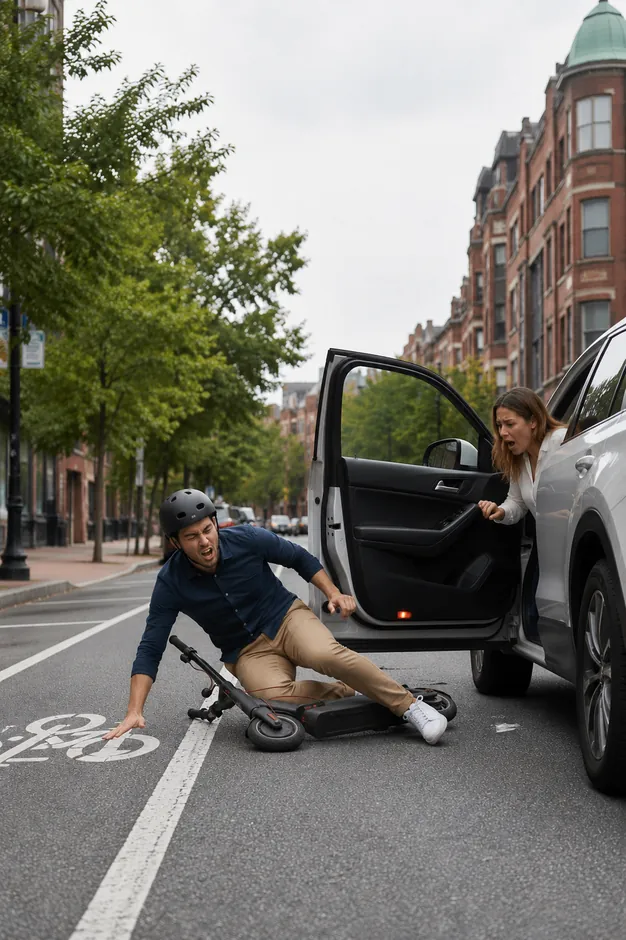
A door opening into a rider is its own category and it is more common than any statistic suggests, because a great many go unreported. The question is rarely whether the door opened. It is who opened it, which is not always the driver, and whether the vehicle was lawfully parked in the first place. A passenger opening a rear door on the traffic side brings that passenger into it, and their cover may be entirely separate from the driver’s. None of that is complicated once somebody asks, and all of it is guesswork if the car has gone before anyone takes the registration.
Position gets argued in predictable ways. A rider in a marked lane is in the strongest position. A rider at the edge of a general lane is fine and will still be described as having come from nowhere. A rider who moved between queued vehicles will be told they did something reckless, whatever the local practice is. What settles it is rarely the rider’s account, because the rider is an interested party. It is the physical damage, the resting positions, and anything that recorded the seconds before.
Riding after dark
Darkness changes the argument rather than the facts. Somebody who genuinely did not see a rider will say so sincerely, and sincerity is not a defence. What matters is whether the scooter was lit, whether the rider was visible to a person who was actually looking, and whether the driver had any position to look from at all. Photographs of the machine’s lights, taken before anyone touches it, do more work here than any amount of description afterwards.
Witnesses behave differently in these than in car crashes, and not in the rider’s favour. Other drivers tend to stay, because their vehicles are involved and they have insurers to notify. People on foot, who often have the clearest view of what a car did, have no reason to wait and no vehicle to identify them by. Whoever was nearest is frequently gone within ten minutes and effectively unfindable afterwards.
There is usually more phone footage than anybody collects. Somebody at the scene filmed it, somebody in a nearby doorway filmed the aftermath, and none of it reaches anyone unless it is asked for early, while people still remember having taken it and have not cleared their phones.
What to gather comes down to a short list. The registration of any vehicle involved, including one that was parked. The names of anybody who stopped, even briefly. Photographs of the machine as it lies, of the road surface, and of whatever the rider was wearing. And the time, precisely, because it is what lets anyone find the footage later.
The face and the hands take most of it.
How somebody comes off a scooter is remarkably consistent, and it decides the injuries. Small wheels stop suddenly, the machine stops with them, and the rider carries on forwards with both hands already reaching. What arrives at hospital follows from that almost every time.
The face takes the worst of it, and faces are expensive in a way people do not anticipate. Teeth lost at the front are not replaced once. A temporary sits for months, an implant follows, and implants themselves get redone at intervals across a life. Dental cover runs out almost immediately in this territory, which leaves the rest of it sitting in the claim or sitting on the household. Scarring across a lip or a chin belongs in the same paragraph, because it is on display in every conversation afterwards.
Hands and wrists are next, and they hide a specific trap. A small bone in the wrist frequently fails to show on the first set of images, so somebody is sent home with a sprain and returns six weeks later with something that has not healed. By then the notes read as though the problem started later than it did. Anyone who works with their hands is looking at a different loss from anyone who does not, and the difference has to be spelled out rather than assumed.
Head injuries on a scooter are usually assessed quickly and discharged the same day, because nothing shows and the person is talking. What comes afterwards is the part that matters: losing words, losing patience, losing the thread of a film. Those arrive over weeks and are only ever connected back to the crash if somebody wrote down when they started.
Delivery riders are a large part of who this happens to, and they lose money in a way an employee does not. There is no sick pay, no phased return, and no employer keeping the job open. Every day off is income that did not arrive, and the record of it sits in an app rather than on a payslip, which means somebody has to go and get it before the account closes or the history rolls off.
The small losses are worth listing even though they feel trivial. A rental charge that kept running after the crash. A phone that was in a hand or a pocket. Clothing cut off in an emergency department. A helmet, if there was one, which has now done its job and cannot be used again. None of these decide a case and all of them are yours.
What holds all of it together is a medical record that keeps pace with the injury rather than stopping at the first visit. On a scooter claim that matters more than most, because the first visit is often brief, the rider is usually still in shock, and several of the injuries above are the kind that get properly noticed a couple of weeks later.
Car-vs-Scooter Crashes
Pothole and Road-Hazard Falls
Defective Scooter Claims
Serious Head and Facial Injuries
Three things settle most of the argument later.
Get care and keep your scooter safe
Get medical attention right away, and if you can, photograph the scene, the vehicle, and the road; keep the scooter exactly as it is, since some defect may matter, and note the names of any witnesses.
Talk with an Everett scooter lawyer
Reach out for a free, private conversation. We work out what really caused the crash, explain how the rules apply, answer any blame the insurer puts on you, and tell you what evidence to preserve now.
We find the cause and press on hard
We reconstruct the crash, secure all the footage and the scooter, deal with the insurers and defense lawyers, and pursue every responsible party for the full cost of a serious injury, not a low offer.
- 5.0 stars out of 100+ reviews
A lawyer can rule
the wrong ones out.
The reason to ask early is not the injury. It is that the three possible causes run on three different timetables, and one of them is very short. A claim against a driver allows time. A claim about the road surface does not, and a claim about the machine depends on the machine still existing in the state it was in. Until somebody works out which of those you have, all three are running. One call is enough to start narrowing it, and narrowing it commits you to nothing.
By submitting this form, you acknowledge that doing so does not create an attorney-client relationship. Please do not include confidential information. Contacting us does not obligate you to retain our services.
Our Clients.


Our Practice Areas.
Larson Law takes scooter cases where the cause is genuinely in question. A driver, the road, or the machine itself leads somewhere different, and sorting that out early is the whole of the early work.
Most of these arrive before anybody has called.
Do I have a claim if a car hit me while I was on a scooter?
Yes, and often a strong one. A rider struck by a car can receive no-fault benefits from the striking vehicle and pursue the at-fault driver for the full injury, without the tort threshold that limits car occupants. The focus is on the driver’s failure to yield or look.
What if I crashed because of a pothole or road defect?
You may have a claim against the public body or contractor responsible for that stretch of road. These cases can carry short notice deadlines when a government entity is involved, so it is important to act quickly and preserve evidence of the hazard.
What if the scooter itself malfunctioned?
If a brake, throttle, or structural part failed, you may have a product claim against the maker, and a rental operator can be responsible for poor maintenance of its fleet. The scooter is the key evidence, which is why keeping it exactly as it is matters so much.
The insurer says I was reckless. Can I still recover?
Yes. Under comparative negligence you can recover unless you were more than half at fault, with any award reduced by your share. Riders are unfairly assumed to be at fault, and we answer that with the physical evidence, witnesses, and reconstruction.
Do I get insurance benefits after a scooter crash?
If a motor vehicle struck you, personal injury protection from that vehicle can pay early medical bills and part of lost wages regardless of fault. Where no vehicle is involved, other coverage and claims may apply, and we sort out which ones fit your case.
How long do I have to file a scooter accident claim?
Generally three years from the crash, but shorter deadlines can apply when a government entity is a defendant. Because evidence — especially the scooter and any camera footage — disappears quickly, it is best to involve a lawyer immediately.
What are the most common causes of scooter crashes?
Drivers turning or pulling out without seeing the rider, dooring beside parked cars, potholes and pavement defects, and scooter malfunctions. Identifying which cause applies decides who is responsible and what evidence must be preserved.
What injuries are common in scooter crashes?
Head injuries, facial and dental damage, wrist and arm fractures from bracing a fall, and spinal injuries are common, and many are serious or permanent. Prompt medical care protects both your health and the record tying your injuries to the crash.
What if the driver fled or had no insurance?
Your own uninsured and underinsured motorist coverage may pay for your injuries when the at-fault driver cannot be found or has too little insurance. We identify every policy that applies and pursue each available source of recovery.
What is my scooter accident claim worth?
There is no fixed figure. Value depends on the severity and permanence of your injuries, your medical costs, lost income, and the pain you endure. Scooter injuries are often severe, and we document each loss so the claim reflects the true cost.
What does it cost to hire a scooter accident lawyer?
Nothing upfront. We work on a contingency fee, so there is no hourly billing and no fee unless we recover for you. The first review of your crash is free, so there is no financial risk in finding out where you stand.
Do you handle scooter crashes beyond Everett?
Yes. We represent injured riders in Everett and the surrounding communities, including Chelsea, Malden, Medford, Somerville, and Charlestown. Reach out by phone or through the form on this page for a free review.
Results Disclaimer: Past case results, settlements, and verdicts mentioned on this website do not guarantee or predict a similar outcome in any future case. Every case is unique and depends on its own facts and legal issues.