

BROOKLINE SCOOTER ACCIDENT LAWYER
Rental scooters left lying on sidewalks trip people walking by.
Rental companies decide where riders may leave their scooters. App records then show which customer parked one across that crowded sidewalk and at exactly what time the trip ended.
- No fee unless we win
- Same-day response
- Free case review
As Seen On:












Shop cameras near a crash usually record over their video within days.
Electric scooters injure two separate groups in this town, the people riding them and the people walking near them. Riders tumble onto asphalt after a swinging car door, a jammed front wheel or an unexpectedly steep downhill run. Walkers stumble over abandoned rental units sprawled across sidewalks, or get clipped by riders weaving through lunchtime crowds. Both groups usually face hospital bills, missed shifts and several weeks of limited movement afterward. Neither group should quietly absorb those losses when somebody else created the hazard behind them.
Responsibility tracks whatever actually triggered the fall or collision, and sometimes several parties contributed together. Motorists who drift into bike lanes or turn without checking mirrors cause many serious rider injuries here. Rental operators may answer for a scooter parked across a walkway or a worn brake nobody bothered fixing. Another rider who speeds along a packed sidewalk can be personally responsible for knocking down a shopper. Whoever maintains a broken curb ramp or sunken drain grate may also shoulder some responsibility here.
Scooter claims opened at this office move forward under the close watch of Daniel J. Larson, reviewing each file closely. That same method drives the firm’s handling of scooter crashes throughout the larger neighboring city, adjusted here for village streets. Early on, each client hears which parties might pay and what proof every insurance company will probably demand. Answers about medical bills, rental apps and claim forms come from someone who has actually read that client’s records. Candid views about weak spots arrive early too, well ahead of any release or settlement signature.
Early work focuses on proof that disappears quickly in a town where so much happens on foot. Rental operators often collect damaged scooters within hours, and storefront cameras overwrite older footage soon afterward. Trip logs, location traces and repair histories get protected through prompt written requests sent to each operator. Bakery clerks, bus riders and other bystanders get interviewed while those details stay fresh in mind. Phone photos showing the scooter’s identification number, the curb and the street surface get collected from clients too.
Quick medical attention matters even when soreness seems minor during that first evening at home. Head and wrist injuries from scooter falls sometimes reveal their full extent only once swelling develops overnight. Hospital notes written early connect each injury directly to that collision, trip or stumble. Keeping torn clothing, a cracked helmet and in-app trip receipts preserves details that insurance companies later question. Hurt riders and walkers should skip recorded statements until someone explains which policies are involved.
Pedestrians hurt by scooters often assume nobody carries insurance for this particular kind of sidewalk accident. Rental companies, delivery businesses and some riders’ household policies frequently do cover those losses after all. An older shopper who trips over a toppled scooter outside a pharmacy entrance may have solid grounds for payment. A nurse struck by a speeding rider near the hospital district may also have options. Untangling which policy pays usually starts with one unhurried conversation covering the scooter, location and injuries.
What our clients say
Hurt riders find lawyers already handling electric scooter claims.
- We handle e-scooter crash claims for riders and for people struck by scooters across Brookline.
- We find every source of fault, whether a careless driver, the scooter company, or a poorly kept road.
- We move fast to preserve the scooter, the ride data, and the scene before that proof can disappear.
- We push back on the quick, low offers insurers make before your injuries are fully understood.
- We build each claim on the ride records, the crash evidence, and the medical proof, not assumptions.
- No fee unless we win
- No upfront costs
- Direct attorney access
- Free case review


Riders obeying street rules keep full rights against careless drivers.
Motorized scooter riders generally travel in the street, keeping right or using bike lanes where painted lanes exist. Motorists overtaking a scooter must leave adequate room rather than squeezing alongside inside one narrow lane. Riders in turn must obey signals, wear a helmet and use a headlight after dark on public ways. Using the road lawfully means a scooter rider keeps every right a cyclist or motorist would have afterward. Riding on sidewalks is generally off limits for motorized scooters, which can matter when insurance companies start dividing blame.
Scooter apps log each trip, its route and its timing.
Rental operators set parking zones inside their apps and often require riders to photograph each parked scooter. When scooters sit across sidewalks or block shop doorways, those end-of-trip photos may show the company had notice. Towns that permit rental fleets commonly require operators to move badly parked units promptly after complaints. Claims involving people on foot who trip over or get hit by scooters frequently start with those parking records. Riders who park carelessly can share responsibility too, though the operator usually holds much larger policies.
Every rental scooter generates data covering trip start and end points, speed readings, braking events and battery status. Maintenance logs show when fleet mechanics last checked brakes, tires, lights and the throttle on that scooter. Fault reports filed by earlier riders can prove the company heard about a loose stem or weak brake beforehand. Operators keep that data only for limited periods, so written preservation requests need sending promptly. Phone screenshots of the trip receipt help confirm exactly which scooter carried the rider that day.
Riders accept a long user agreement before unlocking any rental scooter, and companies often quote it after crashes. Those agreements commonly include arbitration clauses, liability waivers and limits on where lawsuits may proceed. Judges do not automatically enforce every clause, particularly attempts to excuse a company’s own serious maintenance failures. Pedestrians never clicked anything, so a rider’s agreement generally does not bind the walker who got hurt. Reviewing those terms closely is part of the firm’s work with app-based rental fleets before anyone answers the company.
Rental operators typically must carry commercial liability insurance before local towns allow their fleets to operate. That policy may cover injuries caused by poorly maintained scooters or by equipment carelessly left blocking a walkway. Some operators also offer riders limited accident coverage through the app, with separate claim procedures and forms. Locating the correct insurance company early prevents months of letters to an office that never pays. Reporting deadlines under those commercial policies can be short, so prompt written notice protects whoever got hurt.
Household auto insurance usually handles early hospital costs.
Ordinarily, a set limit caps what an auto policy pays toward a struck rider’s earliest medical bills. That money may come from the rider’s own household auto policy or, if no household member owns a car, from the striking car’s policy. Those early payments generally arrive without anyone first proving who caused the collision, which helps families keep up with bills. Lost wages may also be partly covered during that early stretch of recovery. Claim forms for this coverage need prompt filing, since some policies impose deadlines lasting only weeks.
Beyond those first bills, the careless driver’s insurance covers pain, lasting limitations and reduced future earnings. Pain-related damages against a driver usually require either a fracture or medical expenses crossing a threshold amount. Household policies often include underinsured coverage that helps when the driver bought only minimal limits. Fleeing drivers leave riders depending on uninsured coverage, which makes a prompt police report especially important.
Defense lawyers sometimes argue a rider shares fault for speeding, riding at night or ignoring a signal. The state’s rules for dividing blame between people let a rider found no more than half responsible still collect, though at a reduced level. Each award shrinks by the rider’s percentage, so someone found one fifth responsible keeps the remaining four fifths. Trip data showing a moderate speed often rebuts those accusations more convincingly than anyone’s memory.
Some crashes begin with a broken curb ramp, a sunken manhole cover or a raised trench patch nobody repaired. Any town facing a road defect claim must receive written notice, usually within a very short period, describing timing, location and cause. Letting that short window pass can end the claim against the town entirely, even when the defect was obvious. Utility contractors who left a trench uneven may be responsible separately, under ordinary rules with longer deadlines. Careful notice letters are a routine part of the firm’s practice covering dangerous streets and sidewalks during those early days.
Nurses, students and delivery workers ride scooters through these crowded blocks.
Rental scooters end up scattered across sidewalks here, tipped onto their sides outside cafes, banks and shop doorways. Riders finishing a trip often drop them wherever the app allows, however crowded that pavement becomes. Parents pushing strollers, shoppers carrying bags and older residents with canes then have to step around or over them. Evening light makes a fallen scooter nearly invisible against dark pavement, which explains many ankle and wrist injuries here. Each fallen scooter carries a number that ties it to one company and one specific rider’s trip.
Trolley tracks run down the center of the wide boulevard and cross it at several busy intersections. Narrow scooter wheels catch easily in those rails when a rider crosses at a shallow angle instead of straight across. Motorists swinging left across the trolley rails may also cut off riders trying to stay clear of the metal. Wet leaves, snow melt and painted crossing lines make those rails even slicker in colder months. The same trolley line continues into the next neighborhood, where the firm’s guidance for riders across the city line covers similar crossings.
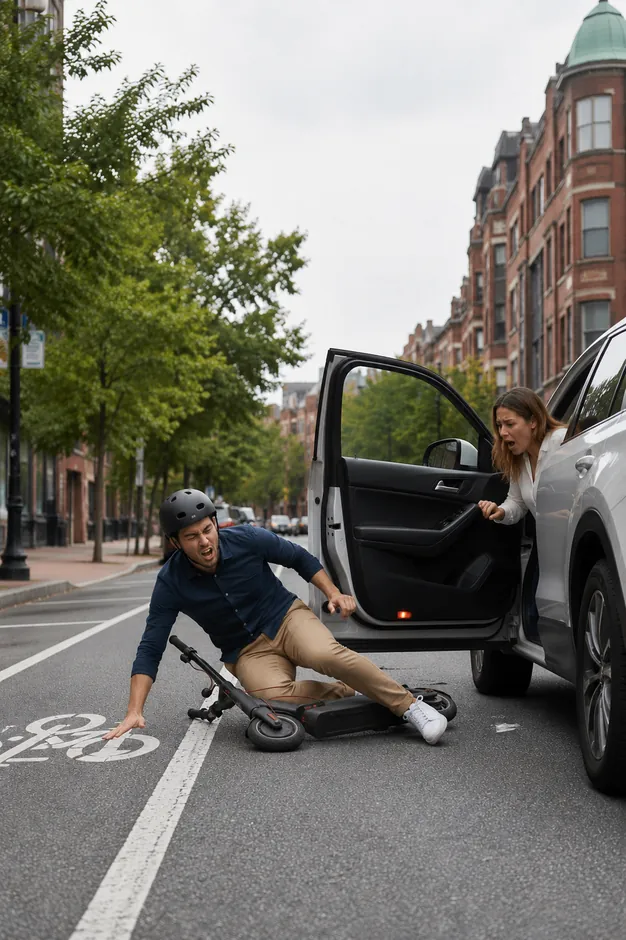
Painted lanes for bicycles on the main commercial avenues run directly beside parked cars and double-parked delivery vans, squeezing riders. Any driver who flings open a door without looking can throw a rider sideways into moving traffic within seconds. Delivery vans stopped inside the lane force riders to swerve out among buses, taxis and impatient commuters. Right-turning drivers often cut across the bike lane without noticing a scooter approaching quietly from behind. Many crashes where a car strikes a rider trace back to those cramped lanes beside parking spaces.
Heavy pedestrian crowds pack the village shopping streets from morning coffee runs until restaurants close each evening. Pedestrians slip out from between parked vehicles, and diners leave crowded patios without checking for scooters. A rider weaving through those crowds at speed can knock down a shopper long before either one reacts. Narrow sidewalks with sandwich boards, bike racks and outdoor tables leave walkers almost no room to avoid a scooter. Shop cameras along these blocks often capture those sidewalk collisions, though recordings rarely survive beyond several days.
Delivery couriers use scooters constantly here, darting between restaurant kitchens and customers waiting across town. Many work under apps that reward speed, which pushes them toward red lights, sidewalks and risky shortcuts. Any delivery rider who strikes a pedestrian may be covered through the delivery platform’s insurance during an active order. Delivery riders themselves also get hurt by drivers and road defects while rushing through their scheduled drop-offs. Records showing whether an order was active at that moment often decide which insurance company pays.
Several steep hills climb from the commercial avenues toward the reservoir, creating long downhill runs for scooters. Scooters pick up speed fast on those downhill grades, and their small brakes struggle once the pavement turns wet. College students commuting toward the trolley often ride those hills in groups, sometimes doubling up on one scooter. A pothole near the bottom of a slope becomes far more dangerous when a rider arrives going fast. Speed readings stored by the rental app can show whether the grade, the brakes or the pavement triggered that spill.
Hospital shifts send scooters out before sunrise.
Nurses, technicians and residents working in the nearby hospital district often commute by scooter for early and late shifts. Dark mornings, tired riders and ambulances racing through narrow streets make that commute more dangerous than many realize. Hospital workers hurt heading to a shift may have claims against a careless driver and sometimes a rental operator too. Hospital employees injured on duty, rather than during the commute, may also fall under workplace insurance rules. Missed shifts for these workers translate directly into lost overtime and night differentials.
Therapy bills, pay stubs and journals prove lasting losses.
Scooter riders thrown forward usually land on outstretched palms, so wrist, elbow and collarbone fractures appear constantly. Surgeons sometimes insert plates or pins, and recovery can take months before a rider can grip a steering wheel again. Claims built around fractures and the surgeries that repair them need careful documentation beginning immediately. X-rays, operative notes and physical therapy records show how severe each break was and how slowly it healed. Pedestrians knocked down by scooters often suffer hip and pelvis fractures, especially older shoppers with fragile bones. Those injuries can end independent living for a while and require rehabilitation stays lasting several weeks. Every bill, appointment and prescription receipt belongs in the claim file, because insurance companies challenge anything undocumented.
Head injuries remain the most serious risk, because a rider’s head often strikes pavement or a car first. Riders without helmets face the greatest danger, but even helmeted riders can suffer concussions from sudden stops. Warning signs including headaches, light sensitivity and forgetfulness sometimes surface only the next morning. Proving concussions and other lasting brain injuries relies on neurological testing and careful records from treating doctors. Spouses and roommates frequently notice mood swings, irritability or confusion that the injured person misses entirely. Brief letters from relatives and coworkers describing those changes demonstrate how ordinary life shifted afterward.
Faces take a beating in scooter falls, especially when the front wheel catches and the rider pitches forward headfirst. Treating broken teeth, jaw fractures, split lips and deep cuts near the eyes can involve dentists, surgeons and cosmetic specialists. Scarring may last for years and affect how someone feels about work, social life and photographs. Cases involving injuries to the face, jaw and teeth depend on photographs taken at every stage of healing. Dentists and plastic surgeons can explain in writing what future procedures will be needed and how much they will cost. Those written opinions help insurance companies understand that the harm continues long after any stitches heal.
Leg injuries also come with these crashes, because riders put a foot down instinctively while trying to stop a fall. Torn ligaments, kneecap fractures and damaged cartilage can require surgery and then repeated physical therapy visits. A rider dealing with torn ligaments and other knee damage may struggle with stairs, standing shifts and driving for many seasons. Road rash covering arms and legs can become infected and sometimes needs skin grafts or repeated wound care visits. Therapy attendance records, home exercise logs and progress notes all show how hard the injured person worked to recover. Treatment gaps attract insurance company scrutiny, so consistent attendance at every appointment matters.
Lost income often weighs as heavily as treatment bills, especially for delivery riders, hospital staff and hourly workers. Wage records from employers, along with tax filings, compare earnings before the crash with income during recovery. Independent contractors can use bank deposits, delivery app summaries and invoices to show typical weekly earnings. Writing daily notes about pain levels, sleep problems and missed family events captures losses that receipts cannot reflect. Travel mileage to appointments, parking charges and paid household help also belong among those records. Scooter riders who relied on rideshares while recovering should save those trip receipts from their phones too. Gathering all of these records early keeps the claim organized and makes the true size of the loss clear.
Medical Bills and Future Care
Lost Wages and Earning Capacity
Pain, Suffering, and Hardship
Wrongful Death of a Loved One
Three early moves protect an injured rider's health and evidence.
Get care, then get the crash report
Get medical care right away, even if you feel fine, since scooter injuries often surface later, and make sure the crash is reported so an official record ties your injuries to what happened out there.
Preserve the scooter, save its data
Photograph the scooter, the scene, and your injuries before anything is moved or repaired, note the scooter's ID and company, and save the ride record in the app, since that data can vanish very fast.
Call a lawyer before any settlement
Before you give any insurer a recorded statement or accept a quick payout, speak with a lawyer first, because early advice preserves the scooter and all the evidence and protects your filing deadline.
- 5.0 stars out of 100+ reviews
Hurt scooter riders get realistic options in one call.
Anyone injured while riding a scooter or walking past one can describe the crash and learn about possible next steps. Phone calls and texts go straight to the team handling the firm’s injury cases from surrounding communities, nearby and downtown. Having trip receipts, crash photos and medical paperwork ready helps that first conversation move further, faster.
By submitting this form, you acknowledge that doing so does not create an attorney-client relationship. Please do not include confidential information. Contacting us does not obligate you to retain our services.
Our Clients.


Our Practice Areas.
Larson Law helps injured people and families across Massachusetts after a serious accident. If you were hurt by someone else’s carelessness, we are ready to listen and explain your options.
Frequent questions concern claim worth, case length and hiring lawyers.
Do I have a personal injury claim?
You may, if a driver, a rental company, another rider or a property owner was careless. The questions are who caused the fall or collision, whether that caused your injuries, and how serious they are. Scooter crashes often involve more than one party, so the trip data, the scene and the insurance all get reviewed early.
What kinds of cases do you handle?
Scooter claims sit alongside the rest of our work: car, truck, motorcycle, bus, rideshare, bicycle and pedestrian crashes, falls on unsafe business property, dog attacks, defective products and wrongful death. Each turns on proving that someone else’s conduct caused the harm and documenting its full extent.
How much is my claim worth?
Value depends on the injuries and their course: medical care now and later, lost pay and earning ability, pain, and damaged property such as the scooter, phone or helmet. Fractures and head injuries are common in these falls, so a fair figure waits until doctors can describe the full recovery.
What if the insurer says I was partly at fault?
Shared fault leaves your claim intact, provided your portion stays at half or lower. Payment drops in proportion, so twenty percent fault leaves eighty percent of the award intact. Exaggerating a rider’s role is common, so trip data showing speed and witness accounts frequently become decisive.
Should I talk to the insurance company?
Carefully, if at all. The driver’s insurer or the rental company’s claims team may call quickly and sound helpful, but their goal is to pay less, and an early recorded statement can be used to suggest the rider was speeding. You can decline politely and send those calls to your lawyer.
How long do I have to file a claim?
Injured adults typically have a fixed period counted in years before their lawsuit deadline passes, and minors generally get that period postponed into adulthood. Towns expect written notice of road defect claims much sooner, sometimes within a very short period. Moving early helps anyway, since scooter companies and shops erase trip data and video quickly.
What if I cannot afford a lawyer?
Money is not needed to start a claim. The lawyer is paid a percentage of any recovery, agreed in writing at the outset, and nothing if the case recovers nothing. Requests for trip data, scene work and medical experts are advanced by the firm while the claim moves forward.
Do I really need an attorney for my claim?
For a scrape and a bruised knee you may not, but fractures, head injuries, a rental company’s user agreement or a disputed fault story usually call for one. Insurers settle for less when nobody pushes back, and deadlines are easy to miss. A short review shows whether a lawyer would change the outcome.
How long will my case take?
That depends on the injuries and the parties. Some scooter claims resolve within months, while serious injuries still healing, a rental company disputing its records or a driver denying fault can push a case toward a lawsuit. Settling before recovery is clear is risky, because a settled claim stays closed.
What if a loved one died from an injury?
Whenever an injury turns fatal, an estate representative can file a wrongful death case benefiting close relatives. Survivors may recover the lost paychecks, companionship and guidance their relative provided, along with funeral bills. Meanwhile, an attorney manages investigation and court filings, freeing relatives to mourn privately.
What if a rental scooter's brakes or wheel failed?
A rental company that leaves a scooter with worn brakes, a loose stem or a damaged wheel on the street may be responsible for the fall. Its maintenance logs and earlier rider complaints often show what the company knew, so those records are requested in writing as soon as possible.
What should I do after an accident?
Get medical care right away, since wrist and head injuries can worsen overnight, and make sure the crash is reported. Photograph the scooter, its ID number, the street and your injuries, save the trip receipt in the app, and avoid recorded statements before speaking with a lawyer.
