

SCOOTER HIT BY CAR LAWYER
A car hit you.
The fault is not yours.
When a car strikes a scooter rider, the driver who failed to look is usually at fault, and Larson Law gathers the proof and pursues the full cost of a scooter crash on your behalf.
- No fee unless we win
- Same-day response
- Free case review
As Seen On:













What a scooter hit by car lawyer looks at first.
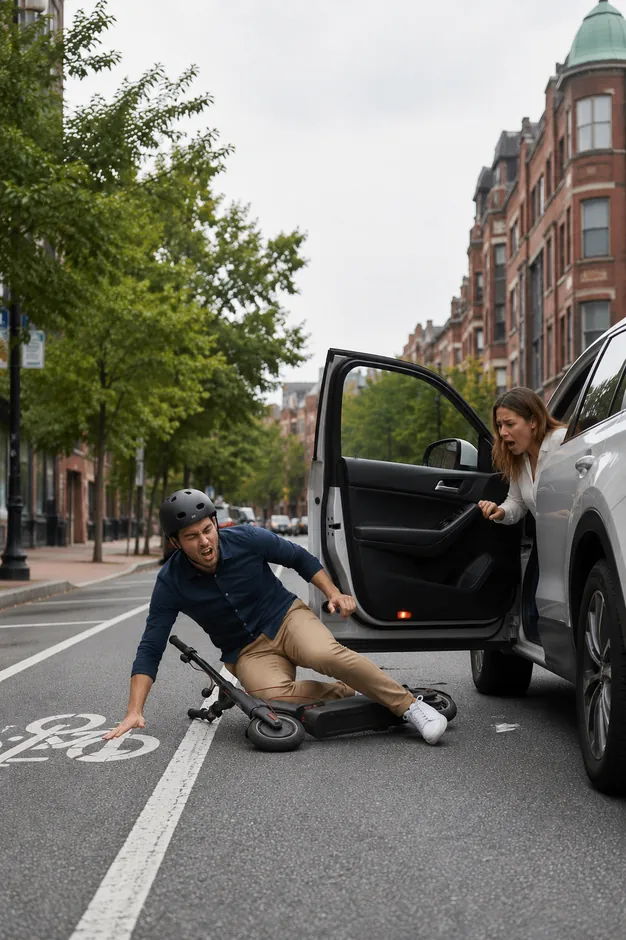
A person on a scooter has almost nothing between their body and the road, so when a car hits them the harm is immediate and often severe. These are not minor spills. A rider struck by a turning, backing, or inattentive driver can suffer broken bones, spinal damage, and head injuries that change a life in an instant, and the driver who caused it will often insist the rider came out of nowhere. In truth, most of these crashes happen because a driver did not look, did not yield, or opened a door into a rider’s path, and the injured rider has a route to hold that driver accountable.
What decides these cases is fault, and fault in a car-versus-scooter crash is rarely as simple as the driver’s insurer wants it to sound. The rider had a legal right to the road, the driver had a duty to watch for and yield to them, and the physical evidence of the crash usually tells the real story. Skid marks, vehicle damage, the point of impact, camera footage, and witness accounts can all show who actually failed to act, and much of that evidence fades or disappears within days unless someone moves to preserve it.
Our team investigates the driver, the scene, and the insurance behind the car, the same disciplined approach we bring to scooter riders hurt in Boston, to the drivers who hit them, and across our wider injury work in the city. Being hit off your scooter by a car is not something you should have to fight over against an insurer alone.
Every case at the firm is handled under the direction of Daniel J. Larson, whose background and credentials are on his attorney profile. From the first conversation you work directly with a lawyer who understands how these crashes happen and who will explain, in plain terms, what your claim involves and what it may be worth.
It also helps to name what these crashes usually are. A driver turning left across a rider’s path, a driver making a right hook across a bike or scooter lane, a driver pulling out from a stop sign or driveway without looking, a driver backing out of a space, and a parked motorist flinging a door open are the recurring patterns. Each of them is a failure of the driver’s duty, not the rider’s fault, and each leaves evidence that a careful investigation can capture.
For the injured rider, none of that legal detail is what they feel at the scene. They feel the impact and the fear and the pain. The work of translating what happened into a claim built on evidence, and of standing between the rider and an insurer trained to shift blame, is exactly what a lawyer is for, and it is why acting early matters so much.
There is also a psychological weight to these crashes that the numbers alone miss. A rider who has been hit once by a car that did not see them often carries real fear back onto the road, and recovery from a serious orthopedic or head injury can stretch across months of appointments, missed work, and lost independence. A claim built carefully accounts for that whole arc, not just the first emergency-room bill, because the law allows a full recovery for the real consequences of someone else’s carelessness.
None of that is something a rider should have to prove alone while they are still healing. The driver’s insurer begins working on its version of events immediately, and an unrepresented rider is at a serious disadvantage against adjusters who handle these claims every day. Getting your own advocate involved early levels that imbalance and makes sure the evidence is captured while it still exists.
The firm brings the same standard to a scooter case that it brings to any serious injury claim: treat the crash as a set of facts to be proven, not a story to be argued. That means going to the scene, securing the footage, documenting the injuries, and building a record strong enough that the driver’s insurer has to reckon with it. That is how a frightening crash becomes a claim grounded in evidence rather than in an adjuster’s assumptions about riders.
What our clients say
Why injured riders trust us with these cases.
- We move fast to preserve the camera footage, vehicle damage, and scene evidence that shows what happened.
- We push back hard when an insurer blames the rider and build the record that shows the driver failed to yield.
- We know how catastrophic a car-versus-scooter impact is and value the claim for its true, lasting effect.
- We deal with the driver's insurer for you, so you can focus on healing, not fighting over your own injury.
- We take these cases on with the investigation, medical proof, and resources a serious claim really needs.
- No fee unless we win
- Free, private case review
- Same-day response
- Honest advice from day one


What decides a scooter rider’s claim.
The rider’s right to the road
Powered two-wheelers have a real place on the road. Powered scooters fall into the same category as motorized bicycles, so the rider has the right to use public ways and carries the same road duties as any other vehicle. This matters because it defeats the insurer’s favorite argument, that the rider should not have been there at all: the rider was lawfully using the road, the driver owed them the ordinary duty of care, and a failure to yield or watch is negligence, not shared blame.
Comparative fault
When an insurer does argue the rider was partly at fault, the split in blame controls the result. An injured rider can recover as long as they were not more than half at fault, and any award is reduced by their share; this matters because insurers routinely exaggerate a rider’s role to cut what they pay, and knowing the rule, and having the evidence to rebut the accusation, is what protects a fair recovery. A helmet dispute or a claim that the rider was too fast is a challenge to be met with proof, not a reason to accept less.
The deadline, and the driver’s duty
Timing is critical. Most injury claims must be brought within three years, but the evidence that proves the driver’s fault can vanish in days, so acting early is what preserves both the proof and the claim. The core principle is simple: a driver must look for and yield to riders lawfully on the road, and when they do not and someone is seriously hurt, the full cost of a life-changing injury should fall on the driver who caused it, not the rider who was struck.
Proving the driver failed
Because a driver will often claim the rider was invisible or reckless, these cases are built from independent evidence. The vehicle’s damage and resting position, the point of impact on the scooter, roadway markings, nearby traffic and business cameras, the police report, and witness statements together reconstruct who actually did what. Much of this is controlled by others or overwritten quickly, which is why a prompt, focused effort to preserve it, and to identify the brain and spinal injuries these impacts commonly cause, is central to the claim.
A traffic violation does not by itself decide a case, but it is powerful. Massachusetts treats a driver’s breach of a traffic rule, a failure to yield, an illegal turn, an unsafe door, as evidence of negligence a jury can weigh, and when the physical evidence supports it, an abstract dispute about who was careless becomes a concrete, documented failure by the driver. That record is what turns a serious crash into a claim built on accountability.
Not every car-versus-scooter crash comes down to a single driver. A poorly designed intersection, an obstructed sightline a property owner failed to trim, or a second vehicle that forced the first into the rider can all contribute, and a claim can be brought against each party whose negligence played a part. Identifying every responsible party matters, because it can be the difference between a recovery capped by one small policy and one that reflects the true cost of the injury.
The insurer’s incentives are worth understanding plainly. From the first call, its goal is to resolve the claim for as little as possible, and a friendly early offer or a request for a recorded statement is part of that effort, not a favor. An injured rider is under no obligation to give the other driver’s insurer a statement, and doing so without advice frequently hands the insurer exactly the ammunition it needs to argue the rider was at fault.
It is worth being clear about the burden as well. The driver’s insurer must prove any fault it wants to assign to the rider, and the rider is presumed to have used due care. That presumption matters, because it means an injured rider does not start the case on the defensive; the driver who failed to yield does.
Where a scooter hit by car lawyer starts looking.
These crashes cluster where cars and riders mix at close quarters, and greater Boston is full of those places. Dense city intersections, streets with on-street parking where doors swing open without warning, bike and scooter lanes that cars cut across when turning, and the busy corridors around campuses and transit stops all put riders directly in a driver’s path. Where the crash happens shapes both how it happened and how the claim proceeds.
Location determines who responds and what records exist. City police typically investigate crashes on municipal streets and generate the report that anchors a claim, while crashes on state roads may draw State Police. Just as important, dense areas tend to have cameras, traffic signals with timing data, and businesses whose exterior video may have captured the impact, and that footage is often overwritten within days unless it is demanded quickly.
Where a rider is struck also affects the injuries and the evidence of them. A low-speed dooring can still throw a rider into traffic; a turning car at an intersection can cause a high-energy impact. Documenting the scene, the sightlines, and the traffic controls is part of showing the driver had time and room to avoid the crash, and it directly affects the income and earning power a serious injury puts at risk.
What the location proves
The specifics of a location often decide a disputed case. A marked crosswalk or bike lane, a stop sign the driver rolled, a driveway with an obstructed view, or a stretch of parked cars all speak to whether the driver met their duty. A reconstruction that ties the rider’s lawful position to the driver’s failure to yield is frequently what defeats an insurer’s attempt to shift blame onto the person who was hurt.
Jurisdiction follows geography too. Whether a crash was on a city street or a state highway can determine which agency holds the report and which court would hear a claim, and those details shape deadlines and procedure. Getting them right from the start keeps a strong case from being weakened by a preventable misstep.
Seasonal and time-of-day patterns matter as well. Low light at dawn and dusk, wet or icy pavement, and the surge of riders in warmer months all raise the risk of a driver failing to see a scooter in time. These conditions do not excuse a driver’s failure to look; if anything, they heighten the duty to drive carefully, and documenting them is part of showing the crash was preventable.
Even the humblest local detail can carry weight. A faded lane line, a sign hidden by foliage, or a crosswalk worn nearly invisible can all bear on whether a driver had a fair chance to see and yield to a rider, and each is worth documenting before it is repaved or repaired.
The costs of being hit off your scooter.
The harm from a car-versus-scooter crash reaches far beyond the emergency room. A complete claim accounts for the surgeries, rehabilitation, and long-term care these injuries demand, and for the pain and the disruption that being thrown from a scooter leaves behind, sometimes permanently. It also has to account for the effect on the ability to earn a living, because serious orthopedic, spinal, and head injuries can keep a person out of work or force a change of career, and a full and careful accounting of every present and future loss is exactly what the driver’s insurer works hardest to minimize.
Proving the full extent of those losses takes preparation. Insurers defend car-versus-scooter claims aggressively, often leaning on the idea that any rider is a risk-taker, and answering that requires medical documentation, the right experts, and a clear, evidence-based picture of how the crash and the injuries actually unfolded. That work is what keeps a serious injury from being resolved for far less than it is worth.
None of this is something an injured rider should manage alone while trying to recover. A free, early conversation can explain what your claim may involve, what evidence must be preserved before it disappears, and what the case may be worth, so your decisions are informed rather than rushed. Because these cases are handled on a contingency fee, that guidance comes with no upfront cost.
Facing the driver’s insurer alone is not a fair contest. The insurer has adjusters and lawyers whose job is to pay as little as possible, and they know an unrepresented rider is unlikely to gather the footage or prove the full value of a claim in time. A lawyer with the resources to investigate, bring in the right experts, and stand firm is what levels the field, and the sooner you reach out, the more of the evidence can be saved.
The right medical documentation is often what separates a full recovery from a shortchanged one. Serious scooter injuries, fractures, joint damage, concussions, and spinal trauma can have consequences that only emerge over time, and a claim resolved too early may leave those future costs uncovered. Building the claim on a complete medical picture, with the input of treating providers and, where needed, independent experts, is what protects against settling for less than the injury will ultimately cost.
Medical Bills and Future Care
Lost Wages and Earning Capacity
Pain, Suffering, and Hardship
Wrongful Death of a Loved One
Three steps to protect your scooter injury claim.
Get medical care and a crash report
Get checked by a doctor right away, even if you feel able to walk, and make sure police document the crash and the car. If you safely can, photograph the scene and vehicle plate and get witness names.
Act fast to save footage and photos
The video and scene evidence that proves the driver failed to yield can be overwritten within days, so a prompt legal notice to preserve nearby footage and the car's data often makes a claim provable.
Speak to a lawyer before you settle
The driver's insurer moves quickly and often blames the rider to cut what it pays, so before you accept an offer or give a statement, a free review shows what the claim is truly worth and protects it.
- 5.0 stars out of 100+ reviews
Talk to a scooter hit by car lawyer today.
If a car hit you while you were riding a scooter, the driver who failed to look is likely responsible, and the proof is fading right now. Talk with our team, or with our wider injury practice in Boston, for a free and private review of how the crash happened and what your claim may be worth. If a rider you love was killed, we can also explain what the loss entitles a family to recover and stand with you through it.
By submitting this form, you acknowledge that doing so does not create an attorney-client relationship. Please do not include confidential information. Contacting us does not obligate you to retain our services.
Our Clients.


Our Practice Areas.
Larson Law helps injured people and families across Massachusetts after a serious accident. If you were hurt by someone else’s carelessness in Boston, we are ready to listen and explain your options at no cost.
Scooter-versus-car crash questions, answered.
Whose fault is it when a car hits a scooter?
Usually the driver’s. Most car-versus-scooter crashes happen because a driver turned across a rider’s path, failed to yield, pulled out without looking, or opened a door into the rider. The rider has a lawful right to the road, and a driver who does not watch for and yield to them is typically at fault.
The driver says I came out of nowhere. Does that hurt my claim?
It is the most common defense, and it rarely holds up against evidence. Vehicle damage, the point of impact, sightlines, camera footage, and witness accounts usually show the rider was visible and lawfully on the road. Proving the driver had time and room to react is what answers that claim.
I wasn't wearing a helmet. Can I still recover?
Often yes. A helmet question goes to comparative fault, not to whether the driver caused the crash. Massachusetts still lets you recover as long as you were not more than half at fault, and a helmet dispute is a challenge to be met with evidence, not an automatic bar to your claim.
What law applies to scooters on the road?
Massachusetts treats motorized two-wheelers, the category that covers many powered scooters, as lawful users of public ways who follow the same traffic rules as other vehicles. That means the driver owed you the ordinary duty of care, and a failure to yield or watch for you is negligence, not a reason to blame you.
Whose insurance pays for my injuries?
Typically the at-fault driver’s auto liability insurance. Depending on the circumstances, other coverage may also apply, such as underinsured motorist benefits if the driver’s limits are too low. Identifying every available source of coverage is part of the claim, because a serious injury can exceed a single policy.
How much time do I have to file?
In most cases you have three years from the date of the crash, though certain situations can change that. Far more urgent, though, is the evidence: camera footage and scene proof that establish the driver’s fault can be lost within days, so it is important to act long before the deadline nears.
What is my claim worth?
It depends on the severity of your injuries and their lasting effect, not on the insurer’s first number. A fair value accounts for medical care and future treatment, lost income and reduced earning power, and the pain and disruption the crash causes. Being thrown from a scooter often causes lasting harm.
The insurer offered a quick settlement. Should I take it?
Be careful. Early offers often come before the full extent of an injury is known and are calculated to close the claim cheaply. Once you accept, you generally cannot reopen it. A free review of the offer against your actual and future losses shows whether it is anywhere near fair.
What should I do right after the crash?
Get medical care and make sure police document the crash and the car. If you safely can, photograph the scene, the vehicle, and its plate and gather witness information. Then speak with a lawyer quickly, before nearby footage is overwritten, and avoid giving the driver’s insurer a recorded statement first.
Do I really need a lawyer for this?
For a serious injury, yes. The driver’s insurer has adjusters and lawyers working to pay as little as possible, often by blaming you. Your own advocate gathers the disappearing evidence, values the claim correctly, and deals with the insurer for you, so you can focus on recovering rather than negotiating.
What does hiring you cost?
Nothing upfront. These cases are handled on a contingency fee, so you owe no attorney fee unless we recover for you, and the first consultation is free. That lets you pursue a full recovery against a well-funded insurer without any financial risk of your own.
Do you handle scooter crashes beyond Boston?
Yes. We represent injured riders across Massachusetts, not only in Boston, and can handle a car-versus-scooter crash wherever it happened in the state. Wherever you are, we can investigate how the crash occurred, prove the driver’s fault, and pursue the full recovery you are owed.
Results Disclaimer: Past case results, settlements, and verdicts mentioned on this website do not guarantee or predict a similar outcome in any future case. Every case is unique and depends on its own facts and legal issues.