

SCOOTER FALL INJURY LAWYER
Your fall may not
be your fault.
When a scooter fall is caused by a bad road, a hazard, or a defect, someone may be liable, and Larson Law finds who is at fault and pursues the full costs of a serious fall injury.
- No fee unless we win
- Same-day response
- Free case review
As Seen On:













What a scooter fall injury claim involves.
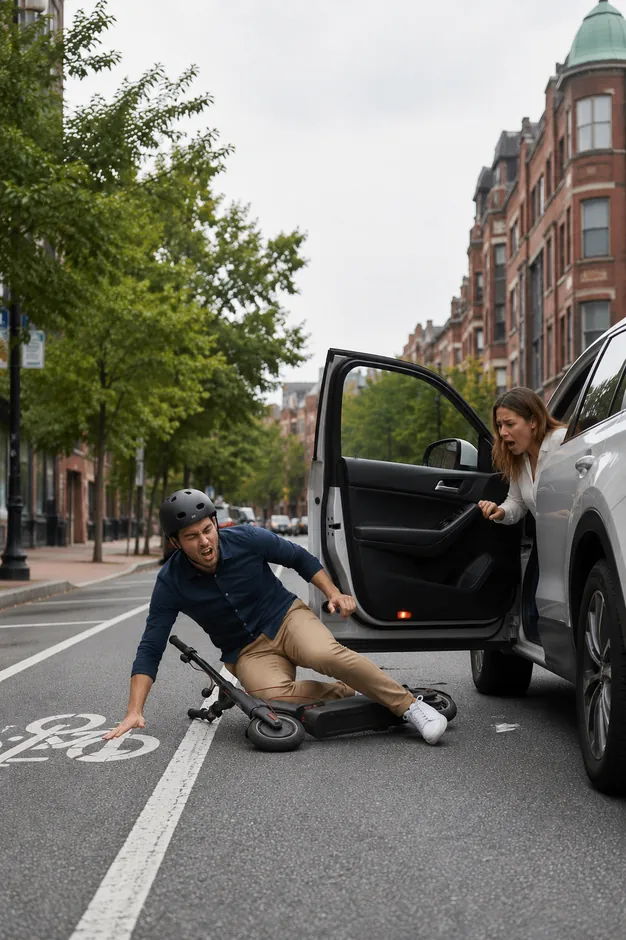
Not every scooter fall is simply the rider losing control. Many are caused by something the rider could not have avoided, a pothole or broken pavement, a sunken utility cover, debris left in a bike lane, a suddenly opened car door, or a defect in the scooter itself. When a fall was set up by someone else’s failure to keep a road, a property, or a product reasonably safe, the injured rider is not simply unlucky; they may have a claim, and Massachusetts law provides a path to hold the responsible party accountable.
The challenge in these cases is that the cause is easy to lose. A city fills a pothole, a property owner clears the hazard, a rental company retrieves the scooter, and within days the very thing that caused the fall is gone. That is why proving a scooter fall turns on early, careful evidence, photographs of the exact hazard, the location, the injuries, and any camera footage, before the scene is changed and the story becomes the rider’s word against a denial.
Our team investigates the road, the property, the scooter, and whoever was responsible for each, the same disciplined approach we bring across our Boston personal injury attorney practice and through our Boston scooter accident lawyer team. A serious fall that someone else caused is not something you should have to prove against a city, a property owner, or an insurer alone.
Every case at the firm is handled under the direction of Daniel J. Larson, whose background and credentials are on his attorney profile. From the first conversation you work directly with a lawyer who understands how these falls happen and who will explain, in plain terms, what your claim involves and what it may be worth.
It also helps to see the range of causes. A dangerous road or sidewalk defect can implicate the city or town responsible for maintaining it; a hazard on private property can implicate the owner; a dooring implicates the driver; and a mechanical failure implicates the scooter’s maker or rental company. Each cause points to a different responsible party and a different set of rules, and sorting them out early is exactly what a proper investigation does.
For the injured rider, none of that is what they feel in the moment. They feel the sudden fall and the pain of an injury they did not expect. The work of showing that the fall was someone else’s fault, and of pursuing the party responsible before the evidence disappears, is exactly what a lawyer is for, and it is why acting quickly matters so much.
What ties these cases together is a simple idea: a person on a scooter is entitled to a reasonably safe place to ride. Roads and sidewalks are supposed to be maintained; properties are supposed to be kept free of hidden dangers; scooters are supposed to work. When one of those duties is broken and a rider is hurt, the fall is not just bad luck, it is the foreseeable result of a failure someone else was responsible for preventing.
That framing matters because insurers and public entities reflexively treat every scooter fall as rider error. Meeting that assumption requires turning the fall back into what it was: the product of a specific, identifiable hazard that a responsible party allowed to exist. Doing that well takes fast action and a careful eye for the evidence, which is exactly what a serious investigation brings.
These falls also carry a hidden frustration: because the rider was alone, with no other vehicle obviously involved, it is easy for everyone, including the rider, to assume nothing can be done. That assumption is often wrong. The road, the sidewalk, the property, or the scooter tells a different story, and a lawyer who looks at the cause rather than the label of a fall can frequently find a responsible party where the rider saw none.
What our clients say.
Why injured riders trust us with these cases.
- We move fast to photograph and preserve the hazard before a city or owner repairs it and the proof is gone.
- We identify who was responsible for the road, property, or scooter, so the right party answers for it.
- We know the short deadlines that apply to claims against a city or town and we protect them from day one.
- We know how serious a fall injury can be and we value the claim for its true and lasting effect on your life.
- We build each claim on real evidence and medical proof, never on an insurer’s assumption that you just fell.
- No fee unless we win
- Free, private case review
- Same-day response
- Honest advice from day one


How the law handles a scooter fall on a bad road.
When a road or sidewalk defect causes the fall
Massachusetts has a specific law for injuries caused by a defective public way. Under G.L. c. 84, § 15, a city or town can be liable when a defect or want of repair it had reasonable notice of causes injury, though the statute imposes a strict cap on what can be recovered and, critically, a very short deadline to give the responsible city or town formal notice of the claim. This matters more than almost anything else in a road-defect case: miss that early notice window and an otherwise strong claim can be lost before it starts, which is why speaking with a lawyer immediately is so important.
When private property or another party is at fault
Not every fall is the city’s responsibility. A hazard on private property, a broken walkway, an unmarked drop, debris, brings the property owner’s duty of reasonable care into play, and a dooring or a defective scooter points to a driver or a manufacturer instead. Each path has its own rules and its own deadlines, and identifying the correct one early is what keeps a viable claim from being pursued against the wrong party or missed entirely. Determining who controlled the hazard is often the first and most important question.
Comparative fault, and the deadline
When a defendant argues the rider simply was not careful, G.L. c. 231, § 85 governs: an injured rider recovers as long as they were not more than half at fault, with any award reduced by their share. And while most injury claims fall under the three-year deadline in G.L. c. 260, § 2A, claims against a public entity carry their own, far shorter notice requirements. This matters because the safe assumption in a fall case is that the clock is short, and the full cost of a serious injury can hinge on acting before a deadline quietly passes.
Proving the fall
Because a defendant will say the rider just lost control, these cases are built from independent evidence. Photographs of the hazard, measurements, the location and its maintenance history, weather and lighting, nearby camera footage, and witness statements together show that a dangerous condition, not the rider, caused the fall. Much of this changes or disappears quickly, which is why prompt documentation, and a clear record of the head and spinal injuries a hard fall can cause, is central to the claim.
Proof that a hazard was known or long-standing is especially powerful. Prior complaints, work orders, inspection records, and how long a defect existed can all show that the responsible party had notice and failed to act, turning a dispute about a fall into a documented failure to maintain a safe road or property. Combined with the medical evidence, that record is what turns a serious fall into a claim built on accountability.
Because different causes carry different rules, one of the first jobs in a fall case is to map the responsible parties correctly. A single fall might implicate a city for a pothole, a utility company for a sunken cover it installed, and a contractor for a poorly marked work zone all at once. Massachusetts law allows a claim against each party whose negligence contributed, and untangling that web early is what keeps a viable claim from being aimed at the wrong defendant or lost to the wrong deadline.
The short deadlines that apply to public entities deserve special emphasis, because they are the most common way a good fall claim is lost. Unlike an ordinary injury claim, a claim against a city or town must be preceded by formal notice within a tight window measured in a handful of weeks, not years. An injured rider who waits, assuming they have the usual time, can forfeit the claim entirely, which is why the very first step after a fall on a public way should be to get advice immediately.
Where a scooter fall injury happens.
Falls happen where the riding surface turns dangerous, and greater Boston has no shortage of rough pavement. Potholes and frost heaves on city streets, sunken or raised utility covers, crumbling bike lanes, streetcar and rail tracks, construction plates, and debris all can throw a rider without warning. Where the fall happened matters, because it determines who was responsible for the surface and which set of rules and deadlines applies.
Location determines who responds and what records exist. A fall on a city street points to the municipality that maintains it and to the very short public-notice deadline that comes with it; a fall on state road or transit property points elsewhere; and a fall on private property points to the owner. City police may document a serious fall, and dense areas often have cameras that captured it, footage that is frequently overwritten within days unless it is demanded promptly.
The setting also shapes the evidence and the injuries. A rider thrown onto pavement can suffer a head, wrist, or spinal injury out of proportion to the speed involved, and documenting the exact hazard, its size and location, before it is repaired is often the single most important step. It also directly affects the income and earning power a serious injury can take away.
What the location proves
The particulars of a place usually decide a fall case. The depth of a pothole, the height of a raised utility cover, how long a defect had gone unrepaired, and whether it had been reported before all speak to whether the responsible party should have fixed it. A careful record that ties the hazard to the fall is frequently what defeats an attempt to write the injury off as simple rider error.
Jurisdiction follows geography, and it carries deadlines. Whether a fall was on a city street, state property, or private land determines not only which party is responsible but how quickly a formal claim or notice must be made, and getting that right at the outset is often what keeps a strong claim alive.
Weather and season play an outsized role in these falls. Freeze-and-thaw cycles open potholes and heave pavement in the colder months, fallen leaves and debris hide hazards in autumn, and construction season fills streets with plates and uneven patches. None of these excuse a failure to maintain a safe surface; they are foreseeable conditions a responsible party is expected to account for, and documenting them is part of proving the fall was preventable.
Even a single documented detail can decide a claim, the depth of a pothole, a prior complaint on file, or a work order that shows the city knew, and gathering those details early is part of what turns a fall into a provable case.
The costs a serious scooter fall can bring.
The harm from a serious scooter fall reaches far beyond the first hospital visit. A complete claim accounts for the surgeries, rehabilitation, and long-term care these injuries can demand, and for the pain and the disruption that a sudden, hard fall leaves behind, sometimes for good. It also has to account for the effect on the ability to earn a living, because a serious head, wrist, or spinal injury can keep a person out of work or force a change of course, and a full and careful accounting of every present and future loss is exactly what a city’s or an owner’s insurer works hardest to minimize.
Proving the full extent of those losses takes preparation. These claims are defended by arguing the rider was careless and by leaning on the short deadlines and damage limits that can apply, and answering that requires the hazard evidence, the right experts, and complete medical documentation. That work is what keeps a serious injury from being resolved for far less than it is worth.
None of this is something an injured rider should manage alone while trying to heal. A free, early conversation can explain what your claim may involve, which deadlines apply and how soon, what evidence must be preserved before it disappears, and what the case may be worth, so your decisions are informed rather than rushed. Because these cases are handled on a contingency fee, that guidance comes with no upfront cost.
Facing a city or a property owner’s insurer alone is not a fair contest, especially under a short clock. They have adjusters and lawyers whose job is to pay as little as possible, and they know an unrepresented rider is unlikely to preserve the hazard or meet the deadlines in time. A lawyer who moves quickly, investigates, and stands firm is what levels the field, and the sooner you reach out, the more of the evidence and the more of your rights can be saved.
The right medical documentation is often what separates a full recovery from a shortchanged one. Injuries common in these falls, wrist and hip fractures, concussions, and spinal trauma, can have consequences that only emerge over time, and a claim closed too early may leave those future costs uncovered. Building the claim on a complete medical picture, with treating providers and independent experts where needed, is what guards against settling for less than the injury will ultimately cost.
Acting quickly protects your position as much as the evidence, and in a fall case it protects your deadline too. The sooner a lawyer is involved, the sooner the hazard is photographed and preserved, the sooner any required public notice is filed, and the sooner the claim is valued against your real losses. When both the proof and the clock can run out in weeks, moving fast is not optional.
The aim throughout is straightforward: to make sure a rider hurt by a hazard someone else should have fixed is not left carrying the cost alone, and to recover everything the law allows before a short deadline or a repaired road can take the claim away.
Medical Bills and Future Care
Lost Wages and Earning Capacity
Pain, Suffering, and Hardship
Wrongful Death of a Loved One
Three steps to protect your scooter fall claim.
Photograph the hazard and get care
Get medical care right away, and if you safely can, photograph the exact hazard clearly, a pothole, cover, or debris, with something for scale, plus the scene, before the road or property is repaired.
Act fast, the deadlines are short
Claims against a city or town carry very short notice deadlines, and hazards get fixed within days, so getting legal help immediately is often what keeps a fall claim from being lost before it begins.
Talk to a lawyer before you settle
The insurer moves quickly and often argues you simply fell, so before you accept an offer or give a recorded statement, a free review shows what your claim is truly worth and protects all your rights.
- 5.0 stars out of 100+ reviews
Talk to a scooter fall injury lawyer today.
If a bad road, a property hazard, or a defect caused your scooter fall, someone else may be responsible, and both the evidence and a short legal deadline are running out right now. Talk with our team, or with our Boston personal injury attorney office, for a free and private review of what caused the fall and what your claim may be worth. If a fall took someone you love, we can also explain what the loss entitles a family to recover.
By submitting this form, you acknowledge that doing so does not create an attorney-client relationship. Please do not include confidential information. Contacting us does not obligate you to retain our services.
Our Clients.


Our Practice Areas.
Larson Law helps injured people and families across Massachusetts after a serious accident. If you were hurt by someone else’s carelessness in Boston, we are ready to listen and explain your options at no cost.
Scooter fall injury questions, answered.
I fell off my scooter. Do I even have a claim?
You might, if something other than your own carelessness caused it. A pothole or broken pavement, a sunken utility cover, debris, an opened car door, or a scooter defect can all make a fall someone else’s fault. Whether you have a claim depends on what caused the fall and who was responsible for that condition.
Who is responsible for a bad road or sidewalk?
Usually the city or town that maintains it, if it had reasonable notice of the defect and failed to fix it. On private property, the owner is responsible for keeping it reasonably safe. Determining who controlled the surface where you fell is the first step in knowing whom to pursue.
Is there really a deadline just to file against a city?
Yes, and it is short. Claims involving a public way or a public entity carry notice requirements that must be met quickly, often long before the general injury deadline. Missing that early notice can end an otherwise strong claim, which is why it is important to speak with a lawyer right away.
The city says the pothole wasn't its fault. How do you respond?
With proof it should have known. Prior complaints, work orders, inspection records, and how long the defect existed can show the city had reasonable notice and failed to act. Combined with photographs and measurements of the hazard, that record answers the claim that the defect was not its responsibility.
What if I fell on private property?
Then the property owner’s duty of reasonable care applies. An owner who created or ignored a hazard, a broken walkway, an unmarked drop, debris, can be responsible for a resulting fall. The same early evidence matters: document the hazard and the scene before the owner repairs or removes it.
They say I just wasn’t careful. Does that end my claim?
No. Even if you were partly at fault, Massachusetts lets you recover as long as you were not more than half to blame, with any award reduced by your share. Evidence about the hazard usually shows a careful rider could not have avoided it, which answers the “you just fell” defense.
How important is photographing the hazard?
Often decisive. The pothole gets filled, the debris gets swept, the broken pavement gets repaved, sometimes within days. A clear photograph of the exact hazard, ideally with something for scale, may be the single best proof that a dangerous condition, not the rider, caused the fall.
What is my scooter fall claim worth?
It depends on the severity of your injuries and their lasting effect, and on which party is responsible, since some claims carry damage limits. A fair value accounts for medical care and future treatment, lost income and reduced earning power, and the pain and disruption the fall causes.
What should I do right after the fall?
Get medical care, and if you safely can, photograph the exact hazard, the scene, and your injuries before anything is repaired. Note the precise location and any witnesses. Then speak with a lawyer quickly, because the evidence and, for public-property claims, the deadline are both short.
Do I really need a lawyer for a fall?
For a serious injury, yes. These claims turn on fast-disappearing evidence and, against a city, on short deadlines that are easy to miss. Your own advocate preserves the hazard proof, identifies the right responsible party, meets the deadlines, and pursues the full value of the claim for you.
What does hiring you cost?
Nothing upfront. These cases are handled on a contingency fee, so you owe no attorney fee unless we recover for you, and the first consultation is free. That lets you pursue a claim, even against a city or a well-funded insurer, without any financial risk of your own.
Do you handle scooter fall cases beyond Boston?
Yes. We represent injured riders across Massachusetts, not only in Boston, and can handle a scooter fall wherever it happened in the state. Wherever you are, we can identify what caused the fall, preserve the proof, meet any deadlines, and pursue the recovery you are owed.
Results Disclaimer: Past case results, settlements, and verdicts mentioned on this website do not guarantee or predict a similar outcome in any future case. Every case is unique and depends on its own facts and legal issues.