

BRIGHTON SCOOTER ACCIDENT LAWYER
Scooter wheels drop into pavement gaps cars never notice.
Whoever must maintain that pavement can owe an injured rider for neglecting repairs. Photographs and repair files reveal how many months the crack, rail gap or pothole sat unfixed.
- No fee unless we win
- Same-day response
- Free case review
As Seen On:













Scooter crash proof gets collected before road crews patch anything.
Electric scooters roll on wheels barely wider than a hand, and that single fact changes everything about a crash. Cracks, track grooves and sunken utility covers that a sedan never notices will stop a scooter instantly. Riders stand upright with nothing around them, so the body takes the whole impact against pavement or steel. Deck speeds feel modest, yet one sudden stop pitches the rider forward across the handlebars headfirst. Hands go out first, then a shoulder or the face meets the ground before any reaction is possible. Falling that way says nothing about rider error, which is exactly where careful review of a crash starts.
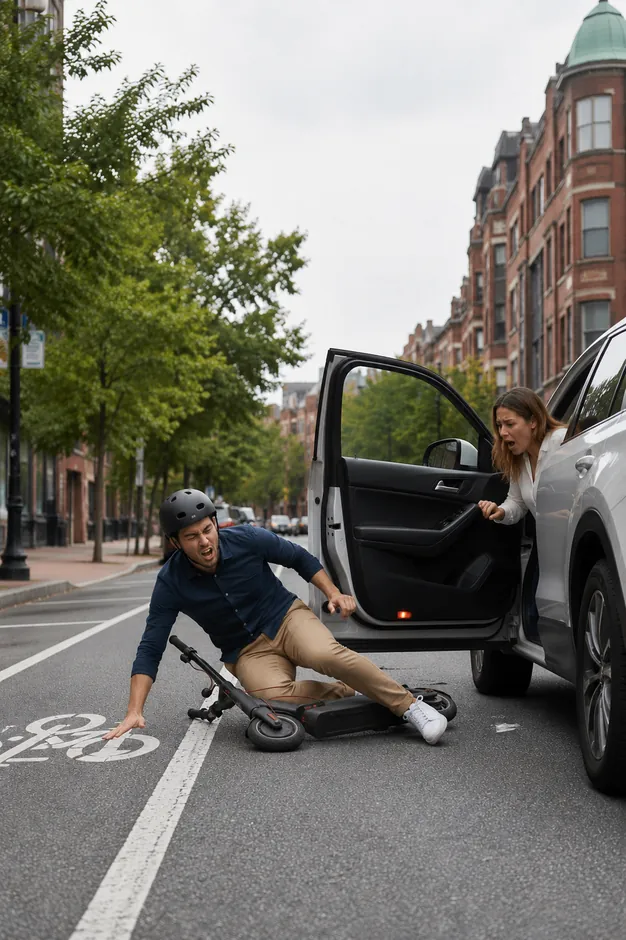
Motorists start plenty of these crashes by swerving through the bike lane or shoving a door open unchecked. Rental fleets owe riders working brakes, sound stems and good tires, and repair logs reveal whether they delivered. Manufacturers answer for design or assembly faults, a subject covered in more depth on our page about scooters that fail mechanically. Maintaining the roadway falls to a city department, a transit agency or a private contractor, each answerable for neglect. Untangling those roles early reveals which insurance policies can actually cover hospital bills and missed shifts.
Scooter files at this office get supervised firsthand by Daniel J. Larson, representing injured people exclusively and insurance companies never. Scooter claims from this neighborhood draw on the same groundwork described for riders hurt elsewhere in the city, adapted to these particular streets. Clients speak with the lawyer handling their file instead of being passed between assistants. Updates arrive in plain language, including the unwelcome ones, so nobody is left guessing about progress. Decisions about settling or going to court stay with the client after an honest talk about risks.
Early work follows a set order because scooter evidence disappears faster than evidence from an ordinary car collision. Rental companies collect a damaged scooter within hours, repair it, and return it to the sidewalk for another customer. Written demands therefore go out immediately asking the company to hold the unit and every byte of ride data. Storefront cameras along the avenue overwrite themselves within days, so nearby businesses receive preservation letters too. Pavement defects get photographed with a ruler beside them before a road crew fills or grinds the spot. Witness names from the police report are followed up while memories of the fall remain sharp.
Meanwhile the rider’s job is medical care, and the paperwork from that care becomes the backbone of everything later. Triage notes written that same night anchor each wound to the collision before anyone can argue otherwise. Callers from insurance companies often ring within days, wanting a taped account of speed, helmets and lane position. Saying no politely, then naming a lawyer, spares a tired and medicated person from guessing on tape. Students who return home for semester breaks can continue their claim remotely by phone, email and video.
What our clients say
Injured riders and injured walkers both receive careful attention.
- We handle e-scooter crash claims for riders and for pedestrians struck by scooters in Brighton
- We find every source of fault, whether a careless driver, the scooter company, or a bad road
- We preserve the ride data, the scooter, and the scene before that proof can disappear
- We push back on the quick, low offers insurers make before your injuries are fully known
- Attorney Daniel J. Larson prepares every scooter case as if it may have to go to trial
- No fee unless we win
- Free, private case review
- Same-day response
- Honest advice from day one


Rental app agreements rarely end an injured rider's claim.
Scooter riders travel under largely the same rules that govern bicycles, which means drivers owe them ordinary care. Yielding before swinging across a marked bike lane is required of motorists, as is generous room while overtaking. Anyone leaving a parked car has to check for approaching riders, a duty explained where we cover doors opened into traffic. Parallel reasoning already protects people injured while cycling, right down to lane position and lighting after dark. Riding lawfully strengthens a case, yet a small rider error usually trims a recovery by a percentage instead of ending it.
Stand-up scooters carry no insurance requirement, yet coverage for an injured rider usually exists somewhere nearby. Car-involved crashes typically trigger an auto policy covering early medical bills, though only up to its stated ceiling. Riders who own a car, or share a household with someone who does, can often draw on that policy too. Couriers carrying food orders for an app occupy a separate category because they were working when hurt. Job classification then decides whether an employer-side claim for wages and treatment runs beside the one against a motorist.
Pavement claims against public bodies run on a far tighter clock than ordinary traffic cases do. Written notice naming the exact spot, the date and the injury must arrive at the proper office within a very short period. Trolley rails add a wrinkle because the transit agency, not the city, may control the strip around them. Municipal payouts for a street defect are also capped, which makes identifying other responsible parties doubly important. Prior complaints and repair logs establish what officials knew, as our discussion of injuries caused by broken or neglected pavement explains further.
Rental companies hold records that riders never see.
Every rented scooter reports its position, speed and battery level to the company’s servers many times each minute. That stream can show whether the scooter slowed normally or stopped dead as the front wheel dropped. Sudden deceleration without any brake input points toward the pavement or the machine instead of the rider. Unlock times and route maps also answer an insurance company’s favorite suggestion, that the rider was racing. Formal written demands, followed by a court order if necessary, are what pry the file loose.
Fleet scooters live outdoors, get knocked over nightly, and are serviced by contract crews paid per unit. Each machine carries an identification number tied to inspections, part swaps, and whatever earlier customers reported wrong. Prior reports of weak brakes or a wobbling stem on that same unit are powerful proof of knowledge. App receipts display the unit number, so riders should screenshot that page before it scrolls away. Without that number, the company may claim it cannot determine which scooter was involved.
Manufacturers enter the picture whenever the failure traces to design or assembly instead of neglected upkeep. Folding latches that release under load, throttles that stick open, and batteries that cut power mid-ride are recurring examples. Safety recalls and service bulletins are public, and comparing them against the model involved takes little time. Owners should store the scooter untouched, uncharged and unrepaired, with the purchase receipt taped to its stem. Throwing a bent scooter away, however tempting, discards the strongest proof any rider will ever hold.
Rental apps make every customer tap through a long agreement before the first ride unlocks. Those terms generally include a release of claims, a promise to inspect the scooter, and an arbitration clause. Courts tend to enforce such language against ordinary carelessness, though rarely against conduct that was grossly careless. Drivers, manufacturers and cities never signed that agreement, so nothing inside it shields them from a rider. Arbitration moves a dispute into a private hearing room without excusing the rental company from answering. Deeper coverage of claims involving app-based fleets sits elsewhere among these pages for riders needing specifics.
Fleet operators usually answer a claim by blaming the rider’s speed, footwear, or failure to complete the pre-ride check. Their own data frequently contradicts that story once somebody outside the company actually reads it. Previous customers photograph the scooter when a ride ends, and those pictures sometimes reveal damage already present. Parking photos are required by most apps, creating an accidental inspection record for each unit. Comparing them in date order shows when a fault appeared and how long the company left it.
Timing ties all of this together, since each source of proof has its own shelf life. Ride data may be retained for months, while a damaged scooter can be scrapped or rebuilt within days. Recall files stay available indefinitely, but the rider’s memory of how the handlebars felt fades quickly. Writing down that recollection the same week gives later testimony something solid to rest on.
Trolley rails cross avenues where students ride beside delivery couriers.
Trolleys occupy the median of the neighborhood’s longest avenue, and their rails cross the roadway at every turnaround. Steel grooves sit at exactly the width that swallows a scooter’s front wheel when approached nearly parallel. Rain makes the rail surface slick as glass, and the pavement beside it heaves each winter. Cars making U-turns through median gaps watch for trolleys and oncoming vehicles, seldom for a scooter. Responsibility for that strip can belong to the transit agency, which changes where written notice must go.
Universities flank the neighborhood on two sides, so each September thousands of new riders arrive unfamiliar with these streets. Many of them rent a scooter for the first time to reach a lecture hall across the avenue. Class changes release waves of people on foot who step off curbs between parked cars while reading phones. Move-in weekend fills every lane with rental trucks, double-parked vans and distracted parents hunting for an address. University cameras and campus police reports can supply proof that city records would never contain.
Clustered around the central intersection are bars, restaurants and the emergency entrance of the neighborhood’s hospital. Ride-hail drivers stop wherever a passenger waves, often cutting straight through the cycling lane toward the curb. Ambulances and patient shuttles add urgent, unpredictable movement to blocks already crowded after dark. People walking between venues are struck by scooters too, and our page for those injured on foot covers that side. Restaurant patios and doorway cameras along these blocks frequently record the moments that matter most.
Food-app couriers on scooters work these same blocks from lunchtime until the kitchens close after midnight. Pay depends on speed, so the app’s timer pushes riders through yellow lights and against one-way streets. Insulated bags strapped to the back shift a scooter’s balance and lengthen the distance needed for braking. Order logs record precisely when a courier accepted a job, picked it up and was hit. That timestamp decides whether the app company’s own coverage for active deliveries reaches the courier.
Several main streets squeeze their painted bike lanes into the gap between moving traffic and curbside parking. Every parked vehicle is a door waiting to open, and a scooter has less room to swerve than a bicycle. Delivery vans treat the lane as a loading zone, forcing riders out into faster traffic without warning. Storm drains and patched utility trenches line the same strip, exactly where a scooter is told to ride. Lane markings stop abruptly at the town line, where different officials maintain the pavement and receive any notice. Crashes just across that boundary belong on our companion page for riders hurt in the neighboring town, which has separate rules.
Along the river, a parkway built for pleasure driving now carries commuters at highway speeds past narrow shared paths. Scooter riders use the riverside path to avoid traffic, then must cross the parkway at unsignaled gaps. Tree roots lift the asphalt path into ridges that are invisible under leaves or at dusk. A state parks agency, not the city, maintains this corridor, so defect notices follow a separate route. Lighting is sparse there, which makes headlight and reflector evidence from the scooter itself unusually important.
Beside the commuter rail stop, a new district of offices, shops and studios has replaced old warehouses. Construction never quite ends there, so steel plates, gravel and temporary curb ramps appear without warning. Garage exits cross the sidewalk and bike lane together, with drivers looking left for cars only. Commuters stepping off trains unlock rental scooters in clusters and scatter across unfamiliar, freshly striped streets. Private developers and their contractors, not public agencies, often control the pavement inside such a project.
Medical records and pay stubs turn scooter injuries into provable losses.
Wrists break more often than anything else because outstretched hands meet the pavement first. Both forearm bones can snap near the joint, and the small bone below the thumb often cracks unseen. That thumb-side fracture hides on early X-rays, so persistent pain calls for a second scan weeks later. Surgeons frequently fix these breaks using metal plates, after which hand therapy continues for a season or longer. Students lose the ability to type or write during exams, and kitchen or lab workers cannot grip tools. Further detail about healing times and hardware appears on our page covering fractures after a crash, wrists included.
Collarbones fail next, since a rider thrown sideways lands on the point of the shoulder. Displaced breaks may need a plate, leaving a visible ridge and a scar beneath a backpack strap. Ligaments joining the collarbone to the shoulder blade tear in the same fall, producing a permanent bump. Rotator cuff damage sometimes surfaces only after the fracture heals and overhead reaching still hurts. Measurements of reach recorded by the therapist show progress, plateaus and lasting limits in plain numbers. Why these claims outlast the sling is explained where we cover damage to the shoulder joint at length.
Faces strike the ground whenever hands fail to arrive in time, and handlebars cause their own damage. Broken teeth, split lips, fractured cheekbones and jaw injuries are common among riders pitched over the front. Dental reconstruction proceeds in stages across a year or longer, with implants needing replacement decades afterward. Scars across the chin or forehead matter enormously to a twenty-year-old interviewing for a first career. Weekly photographs during healing document what a single emergency room picture cannot convey. Treatment paths and future costs for wounds across the face and jaw have their own discussion, dental work included.
Helmets reduce head injuries without preventing them, and rental scooters almost never come with one. Brief confusion at the curb, forgotten minutes, or vomiting that evening all warrant prompt medical evaluation. Long after visible wounds close, riders may still battle headaches, light sensitivity, poor sleep and scattered concentration. University coursework exposes these problems quickly, because reading and screens become exhausting within minutes. Academic accommodations, withdrawn classes and notes from professors give an unseen injury a paper trail. Testing and long-term effects are explored where we discuss lasting harm to the brain and its slow rehabilitation.
Road rash sounds minor until asphalt has scraped through every layer of skin across a hip or forearm. Deep abrasions trap grit that must be scrubbed out, sometimes under sedation, to prevent permanent tattooing. Infection threatens every large wound, and the worst ones require grafts taken from the thigh. Healing skin stays discolored and sun-sensitive for years, restricting outdoor work and sport. Dressing changes are painful daily events, so a short written log of them carries surprising weight. Torn clothing and shoes from the slide belong in a sealed bag, never the laundry or trash.
Documenting losses means gathering ordinary paperwork that proves what the injury changed in work, study and daily routine. Evidence for the medical side comes from hospital bills, pharmacy receipts, therapy invoices and whatever future treatment doctors foresee. Pay stubs, shift schedules and a manager’s letter prove wages missed by servers, couriers and research assistants. Tuition for a repeated semester, a lost internship or a forfeited athletic season counts too. Disruption and pain are harder to price, so a brief daily journal supplies the missing detail. Friends, classmates and coworkers who watched the recovery can confirm what the records only outline.
Medical Bills and Future Care
Lost Wages and Earning Capacity
Pain, Suffering, and Hardship
Wrongful Death of a Loved One
Doctor visits, saved ride records and early advice protect riders.
Get medical care and a crash report
See a doctor right away, even if you feel okay, and make sure the crash is reported to police. Fast care builds a record tying your injuries to the wreck, which insurers question if you wait too long.
Secure the scooter and the evidence
Photograph the scooter, the scene, and any injuries before anything is moved or repaired. Note the scooter's ID and company, save your ride record in the app, and get names and numbers from witnesses.
Talk to a lawyer before the insurer
Before you give an insurer a statement or accept a quick payout, talk with a lawyer who can sort out the coverage. Early advice shields the evidence and your deadline while you focus on your recovery.
- 5.0 stars out of 100+ reviews
One conversation shows whether scooter injuries support claims.
Scooter riders injured in this neighborhood can call or write, describe what happened, and get straight answers. Bring the app receipt, any photographs, and the hospital discharge papers if they are handy. Injuries of other kinds go through our citywide injury practice, which shares the same staff. Conversations stay private regardless of whether anyone decides to pursue a case afterward.
By submitting this form, you acknowledge that doing so does not create an attorney-client relationship. Please do not include confidential information. Contacting us does not obligate you to retain our services.
Our Clients.


Our Practice Areas.
Larson Law helps injured people and families across Massachusetts after a serious accident. If a scooter crash has left you hurt in Brighton, we are ready to listen and explain your options.
Scooter riders frequently ask which policy pays medical bills.
Do I have a claim if a car hit my scooter?
Very likely, if the driver was careless. A motorist who fails to yield, turns without looking, or opens a door into your path can be liable for your injuries. The work lies in proving that carelessness and identifying the insurance that should pay, which starts with the crash report, the scene, and your medical records.
What if the scooter was defective?
Responsibility then shifts toward the company that built, sold or maintained the scooter. Sellers answer when a scooter leaves them unreasonably dangerous for normal riding, such as failed brakes or a stuck throttle. Leave the scooter untouched, because the machine itself is the strongest proof of the failure.
What if I hit a pothole or road hazard?
You may. A deep pothole, a sunken cover, or a neglected rail crossing can throw a rider, and whoever had to maintain that spot may share the blame. Claims over public roads require written notice within a very short period, so photograph the hazard before it is repaired and get advice quickly.
What if I was a pedestrian hit by a scooter?
Yes. A rider who was careless, whether by going too fast, riding where scooters do not belong, or failing to watch for people on foot, can be responsible for your injuries. Depending on the facts, a rental or delivery company may share that responsibility. The first step is identifying the rider and any coverage.
Whose insurance pays after a scooter crash?
The answer follows the fault. When a driver caused the crash, that driver’s automobile policy is the first place to look, and a policy in your own household may also apply. A defect points toward the maker or rental company, and a road hazard toward whoever maintained the road.
How long do I have to file a claim?
Courts generally give a fixed period for bringing a crash injury case, a window paused during childhood for anyone hurt underage. Cities and public agencies must receive written word of a road defect far sooner, within a very short period. Moving early also saves the scooter, its ride data and nearby video before they are erased.
What if I was partly at fault?
Money stays recoverable provided your assigned portion of blame never rises past half. Payment then shrinks by exactly the percentage assigned to you, so a quarter share removes a quarter. Scooter riders routinely get blamed too heavily, so evidence of speed, lane position and lighting becomes important.
What is a claim like this worth?
It depends on the injuries and how long their effects last. Medical bills, future care, lost wages and earning ability, pain, and the effect on daily life all count. Riders are exposed and often badly hurt, yet the insurance available varies with who was at fault, so both sides of that equation are reviewed.
Should I take the insurer's first offer?
Usually not before getting advice. A first offer tends to come quickly and is designed to close the claim cheaply, before the full extent of your injuries is known. Once you accept, the claim generally cannot be reopened for later costs, even if your condition worsens. Have the offer compared against your actual losses.
What if a loved one died in the crash?
Fatal scooter crashes allow close relatives to bring a claim through the estate of the person lost. Lost income, care, companionship and guidance are all recoverable, as are funeral expenses. Filing waits until a court formally names the person who will represent that estate.
What does a lawyer cost?
Nothing is due at the start. The lawyer is paid a percentage of the money recovered, under a written agreement, and is owed nothing when nothing is recovered. The firm advances the cost of investigating the crash, preserving the scooter and its ride data, and hiring any experts the case needs.
What should I do right after a scooter crash?
Get medical care right away, even if you feel fine, and make sure the crash is reported to police. Photograph the scooter, the scene, and your injuries, and note the scooter’s identification number and company. Save the ride record in the app, take witness names, and decline recorded statements until you have advice.