
Scooter accident injury claims have become far more common as electric scooters fill sidewalks, bike lanes, and busy streets across the Commonwealth, and many injured riders are stunned to learn how uncertain the law can be. When a rider is hurt, scooter accident injury claims raise hard questions about who was at fault, which insurance applies, and whether a scooter even fits the rules written for cars and bicycles. This guide explains how these claims work in Massachusetts, who may be responsible, and how a personal injury lawyer can help an injured rider pursue a fair recovery.
What scooter accident injury claims involve in Massachusetts
A scooter accident injury claim is a request for compensation brought by a rider, or sometimes a pedestrian, who was hurt in a crash involving an electric scooter. These claims can arise from a collision with a car, a fall caused by a road defect, a mechanical failure of the scooter itself, or a crash with a pedestrian or cyclist. What ties them together is the need to show that someone’s negligence, or a dangerous condition, caused the injury and the resulting losses.
Because scooters are small, fast, and offer almost no protection, even a low-speed crash can cause serious harm. Riders stand upright with nothing between them and the pavement or a vehicle, so the injuries in scooter accident injury claims are often more severe than the modest speeds might suggest. Understanding the claim process early helps injured riders avoid missteps that can weaken an otherwise strong case.
How Massachusetts law treats electric scooters
One reason scooter accident injury claims can be complicated is that Massachusetts law has struggled to keep pace with the technology. State law addresses motorized scooters in Massachusetts General Laws Chapter 90, Section 1E, which sets rules such as a minimum operating age, a helmet requirement, limits on nighttime riding, and speed restrictions. However, the shared stand-up electric scooters that appeared through rental programs do not fit neatly into the older categories written for mopeds and traditional motorized scooters.
This gray area matters because the classification of a scooter can affect which rules apply and which insurance may respond. Some communities have run pilot programs with their own local regulations, adding another layer of rules that vary from city to city. The practical result is that two similar crashes can be governed by different requirements depending on where they happen and what type of scooter is involved. A personal injury lawyer familiar with local rules can help sort out which laws apply to a specific scooter accident injury claim.
Common causes of scooter crashes
Identifying the cause of a crash is the foundation of any claim, because the cause points to who may be liable. Scooter accident injury claims tend to arise from a handful of recurring situations.
Road hazards and poor infrastructure
Scooters have small wheels that catch easily on potholes, cracks, uneven pavement, streetcar tracks, and debris. A defect that a car would roll over without notice can throw a scooter rider to the ground. When a poorly maintained public road causes a crash, a claim against the responsible government entity may be possible, though these claims follow special rules and tight deadlines.
Driver negligence and dooring
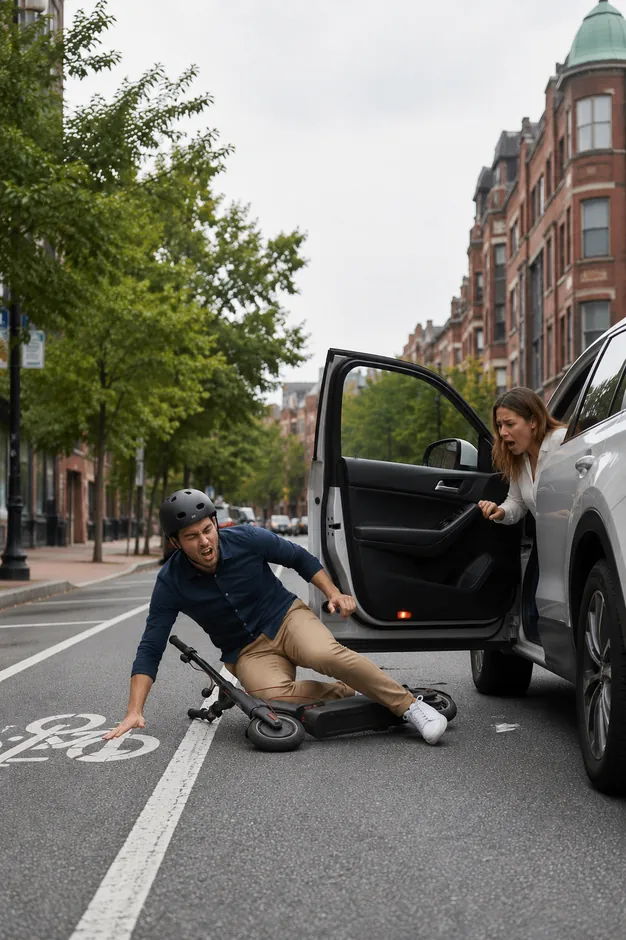
Many of the most serious scooter accident injury claims involve a motor vehicle. Drivers often fail to see scooters, turn across their path, pull out from parking, or open a car door directly in front of a rider, a hazard known as dooring. In these situations, the driver’s negligence is usually the central issue, and the driver’s auto insurance becomes an important source of recovery.
Defective scooters and mechanical failure
Scooters that are poorly maintained or defectively designed can fail without warning. Brakes that do not respond, throttles that stick, wheels that lock, or frames that crack can all cause a crash. When a mechanical failure is to blame, the claim may target the company that owns and maintains a rental fleet or the manufacturer of a defective component.
Rider visibility and shared-space conflicts
Scooters often share crowded space with pedestrians and cyclists, and conflicts arise when riders are forced onto sidewalks or when others step into their path. Poor lighting and a lack of dedicated lanes add to the risk. Sorting out fault in these mixed situations is a delicate task, and it frequently determines the strength of a scooter accident injury claim.
Who may be liable in scooter accident injury claims
One of the first questions in any scooter accident injury claim is who should be held responsible. The answer depends on the facts, and more than one party may share the blame.
Negligent drivers
When a motorist causes the crash, that driver and their insurer are usually the primary target of the claim. Massachusetts follows a comparative fault system, so a driver who was mostly at fault can be held responsible even if the rider made a minor mistake.
Scooter rental companies
Companies that operate rental fleets have duties to maintain their scooters and to warn users of known hazards. If a poorly maintained or defective rental scooter caused the crash, the operator may be liable. These companies also use lengthy user agreements that attempt to limit their responsibility, and evaluating those terms is an important part of the analysis.
Government entities responsible for the roads
When a pothole, broken pavement, or another road defect causes a crash, the city, town, or state agency responsible for maintaining that road may bear responsibility. Claims against government entities are governed by the Massachusetts Tort Claims Act and by road defect statutes, both of which impose strict notice requirements and shorter deadlines that make prompt action essential.
Scooter and component manufacturers
If a design or manufacturing defect in the scooter contributed to the crash, the manufacturer may face a product liability claim. These cases require preserving the scooter and often depend on expert analysis of what failed and why.
The insurance problem in scooter accident injury claims
Insurance is often the single most confusing part of scooter accident injury claims, because scooters do not carry the mandatory insurance that cars do. When a rider is injured, the available coverage depends heavily on how the crash happened.
If a motor vehicle was involved, the driver’s liability insurance is usually the leading source of compensation. Massachusetts also has a personal injury protection system under Massachusetts General Laws Chapter 90, Section 34M, which provides certain no-fault benefits to people injured in motor vehicle accidents. Whether and how those benefits reach a scooter rider can be complicated and may depend on the rider’s own auto policy or the policy of the vehicle involved. Riders who have their own auto insurance may also have uninsured or underinsured motorist coverage that helps when the at-fault driver has little or no insurance.
When no car is involved, the picture changes again. Health insurance often becomes the primary way medical bills are paid, and any claim for additional compensation may depend on the rental company’s coverage or a product liability theory. Because these coverage questions are so tangled, a personal injury lawyer can be especially valuable in identifying every policy that might apply to a scooter accident injury claim.
Injuries commonly seen in scooter crashes
The lack of protection on a scooter means injuries are often significant. Riders frequently suffer head injuries and concussions, especially when they are not wearing a helmet or when a helmet does not prevent the impact. Broken bones in the wrists, arms, shoulders, and ankles are common as riders instinctively try to break a fall. Facial and dental injuries occur when a rider goes over the handlebars, and severe road rash can require extensive wound care.
More serious crashes can cause spinal injuries, internal trauma, and traumatic brain injuries with lasting effects. Because some of these injuries, particularly head injuries, may not show their full impact right away, riders should seek prompt medical evaluation even if they feel able to walk away. That medical record also becomes a cornerstone of any scooter accident injury claim.
What to do after a scooter crash
The steps a rider takes immediately after a crash can shape the strength of a claim. If possible, the rider should call for help, seek medical attention, and report the crash to the police so there is an official record. Photographs of the scene, the scooter, any vehicle involved, the road conditions, and the injuries are extremely valuable. Getting the names and contact information of witnesses and any driver involved is equally important.
For rental scooters, riders should document the scooter’s identification details and preserve the app records showing the ride. If a mechanical failure occurred, avoiding further use and reporting the defect helps preserve evidence. Finally, riders should be cautious about giving statements to insurers before understanding their rights, and should consider speaking with a personal injury lawyer who can guide them through the process.
Proving a scooter accident injury claim
Winning a scooter accident injury claim requires connecting the crash to another party’s negligence or to a dangerous condition, and then documenting the full extent of the harm. Evidence that strengthens these claims includes photographs, video from nearby cameras or a rider’s own device, police reports, medical records, witness statements, and, when a defect is alleged, the scooter itself.
Causation is frequently contested. A driver may claim the rider darted into traffic, a rental company may argue the rider misused the scooter, and a municipality may deny that a road defect existed. Anticipating these arguments and gathering evidence to answer them is a central task in preparing a scooter accident injury claim, and it is where experienced representation makes a real difference.
Deadlines and notice rules that affect these claims
Massachusetts imposes strict deadlines, and they are even shorter and more demanding when a government entity is involved. Most personal injury actions must be filed within three years under Massachusetts General Laws Chapter 260, Section 2A. When a claim is against a city, town, or state agency, the Massachusetts Tort Claims Act, found in Massachusetts General Laws Chapter 258, requires that a written presentment be delivered to the proper official within two years, well before any lawsuit. Claims based on a road defect can carry an even shorter notice requirement measured in days.
Missing any of these deadlines can permanently end a claim, no matter how serious the injury. Because scooter crashes so often involve possible government responsibility for road conditions, the safest course is to consult a personal injury lawyer quickly so that no notice requirement slips by.
Damages available in scooter accident injury claims
When a scooter accident injury claim succeeds, compensation aims to restore what the injured rider lost. Recoverable losses commonly include medical expenses for emergency care, surgery, and rehabilitation, future medical costs for ongoing treatment, lost wages and reduced earning capacity, and compensation for pain, suffering, and the loss of enjoyment of daily life. When injuries are permanent, the long-term consequences weigh heavily in the value of the claim.
Rather than focusing on figures, injured riders are best served by documenting every effect of the crash, from the first hospital visit through the lasting impact on work, hobbies, and family life. A personal injury lawyer helps ensure that both the immediate and the long-term losses are fully accounted for.
How a personal injury lawyer helps with scooter accident injury claims
Scooter accident injury claims combine unsettled law, tangled insurance, and multiple potential defendants, which makes them harder to navigate than a routine crash. A personal injury lawyer brings order to that complexity by investigating how the crash happened, identifying every liable party, tracking down the insurance coverage that applies, and meeting the strict notice and filing deadlines that these cases demand.
Just as important, a lawyer handles the pressure of dealing with insurers and rental companies so the injured rider can focus on healing. If a scooter crash has injured you or someone you love, the team at Larson Law can review the circumstances and explain your options. You can learn more about the firm’s scooter accident representation, explore help through the Boston scooter accident team, review the full list of services on the practice areas page, and reach out through the contact page to discuss your situation. Riders who want to understand safety issues more broadly can review guidance from the nonprofit National Safety Council and reporting from Consumer Reports.
Separating rider fault from driver fault
Fault is rarely as simple as it looks, and in scooter accident injury claims the question of who was careless often decides everything. Drivers and their insurers routinely argue that the rider appeared suddenly, rode against traffic, ignored a signal, or was traveling too fast. Riders, in turn, may point out that the driver failed to check a blind spot, turned without looking, or opened a door into the travel lane. Because scooters move differently from both cars and bicycles, reconstructing exactly what happened takes careful attention to the physical evidence and the road layout.
Massachusetts uses a comparative fault approach, which means responsibility can be divided among the parties. A rider found partly at fault can still recover, as long as the rider’s share of the blame does not exceed the combined fault of the others, with any award reduced by the rider’s percentage. This makes the fault analysis more than an academic exercise, because every percentage point can change the outcome of a scooter accident injury claim. Building a clear, well-supported account of the crash is one of the most important things an injured rider and their lawyer can do.
Special issues with rental scooter companies
Shared scooters have added a new layer of complexity to these claims. When a rider unlocks a rental scooter, they typically agree to a long set of terms that most people never read. Those agreements often try to limit the company’s liability, require disputes to go through arbitration, and place responsibility for safe operation entirely on the rider. Whether such terms are enforceable in a given situation is a legal question that deserves careful review rather than assumption.
Rental companies also control valuable evidence. They know when a scooter was last inspected, whether it had prior mechanical complaints, and where it traveled during a ride. Preserving that information quickly matters, because records can be lost or overwritten. A rider pursuing a scooter accident injury claim against a rental operator benefits from a lawyer who knows how to request and preserve this data before it disappears. The company’s duty to maintain its fleet and to remove unsafe scooters from service can become the heart of the case when a mechanical failure is involved.
These operators are backed by substantial resources and experienced claims teams. They may reach out early, express sympathy, and offer a quick resolution that seems convenient. Injured riders should be cautious, because an early offer rarely accounts for the full and long-term cost of a serious injury. Understanding the true value of a claim before responding is essential.
When a scooter rider is blamed for hitting a pedestrian
Not every scooter accident injury claim involves an injured rider. Sometimes a rider is accused of striking a pedestrian, particularly in crowded downtown areas where scooters and foot traffic mix. In these situations the roles reverse, and the rider may face a claim rather than bring one. Even here, the analysis is rarely one-sided. Poor infrastructure that forces scooters onto sidewalks, inadequate lighting, or a pedestrian stepping into a lane without looking can all affect who bears responsibility.
Riders who find themselves accused of causing harm should take the situation seriously and seek legal guidance. The same comparative fault principles apply, and a careful look at the circumstances often reveals that responsibility is shared. Having a personal injury lawyer evaluate the facts helps ensure that a rider is not held to answer for more than their fair share.
Why the long-term effects matter
One of the most common mistakes injured riders make is settling a claim before the full extent of their injuries becomes clear. Some scooter crash injuries, especially concussions and other head injuries, evolve over weeks or months. Symptoms such as headaches, difficulty concentrating, mood changes, and sleep problems can appear well after the crash and can interfere with work and relationships. Orthopedic injuries may require follow-up surgeries or leave lasting limitations.
Once a claim is settled, it generally cannot be reopened, even if the injury turns out to be worse than expected. That is why documenting the recovery over time and understanding the likely long-term prognosis is so important before agreeing to any resolution. A personal injury lawyer helps injured riders resist pressure to settle quickly and instead pursue compensation that reflects the true, lasting impact of the crash on their lives.
How insurers and companies try to limit what they pay
Every party defending a scooter accident injury claim has a financial interest in paying as little as possible, and they use predictable strategies to do so. They may argue that the rider was mostly at fault, that the injuries were pre-existing, or that the rider failed to follow safety rules. They may request a recorded statement in the hope of capturing an offhand comment that can be used later, or ask the rider to sign broad medical authorizations that reveal unrelated history.
Recognizing these tactics is the first step to defeating them. An injured rider does not have to face them alone, and often should not. A personal injury lawyer manages communications, protects the rider from making statements that could be twisted, and builds the evidence needed to counter each argument. This is particularly valuable in scooter cases, where the novelty of the technology gives insurers room to muddy the question of fault and coverage.
Putting the pieces together after a scooter crash
The days and weeks after a scooter crash can be overwhelming, especially when injuries make everyday tasks difficult. Between medical appointments, missed work, and calls from insurers, it is easy to feel that the process is stacked against you. Yet the injured rider holds real rights under Massachusetts law, and taking a few organized steps can protect those rights. Keeping medical records, tracking expenses and missed work, saving all crash-related documents, and avoiding early settlement offers all preserve the strength of a claim.
Above all, acting promptly matters. Evidence fades, deadlines run, and the parties who may be responsible begin building their defense from the moment the crash occurs. Reaching out to a personal injury lawyer early does not commit an injured rider to litigation. It simply ensures that someone is protecting their interests, preserving evidence, and preparing the scooter accident injury claim properly while the rider focuses on getting better.
Scooter safety and how crashes can be prevented
While the responsibility for a crash usually lies with a negligent driver, a dangerous road, or a defective scooter, riders can reduce their risk with a few habits. Wearing a properly fitted helmet lowers the chance of a serious head injury. Inspecting a rental scooter before riding, checking the brakes and tires, and refusing to ride a scooter that feels unsafe can prevent mechanical failures. Riding predictably, using lights at night, staying out of blind spots, and watching for opening car doors all help a rider stay visible and avoid the most common collision patterns.
These precautions do not shift the blame onto riders who are hurt through no fault of their own, and they do not weaken a legitimate scooter accident injury claim. Massachusetts law still holds negligent drivers, careless companies, and responsible government entities accountable when their conduct causes harm. Safety habits simply reduce the odds of a crash and, when one does happen, can help demonstrate that the rider behaved reasonably.
What makes scooter accident injury claims different from bicycle claims
Riders sometimes assume that a scooter crash will be handled just like a bicycle crash, but there are meaningful differences. Bicycles have a long-established place in Massachusetts law, with recognized rights and duties on the road. Electric scooters, by contrast, occupy a newer and less settled legal space, which affects everything from which rules apply to how insurers respond. Scooters also behave differently in a crash, with smaller wheels that are more sensitive to road defects and a riding posture that changes how a rider falls.
These distinctions influence how a scooter accident injury claim is built and argued. Evidence about the type of scooter, the local rules in effect, and the mechanical condition of the device can all matter in ways that do not arise in a typical bicycle case. Because the law continues to develop, working with a personal injury lawyer who follows these changes helps ensure a claim is presented under the most current and favorable framework available.
Taking the first step
A serious scooter crash can upend a person’s life in an instant, replacing routine days with pain, medical bills, and uncertainty about the future. The good news is that injured riders in Massachusetts have real options, even when the law seems murky and the insurance picture looks confusing. The key is to act while evidence is fresh and deadlines are still open. A conversation with a personal injury lawyer can clarify who may be responsible, which insurance applies, and what a fair recovery might look like, giving an injured rider a clear path forward rather than a maze of unanswered questions.
The role of medical documentation in scooter accident injury claims
Medical records are the backbone of scooter accident injury claims, because they translate a rider’s pain and limitations into evidence an insurer or a court can evaluate. Seeking care promptly after a crash does two things at once. It protects the rider’s health by catching injuries that may not be obvious, and it creates a contemporaneous record connecting the crash to the harm. Gaps in treatment or long delays in seeing a doctor give insurers an opening to argue that an injury was not serious or was caused by something else.
Riders should follow through on recommended treatment, keep appointments, and describe their symptoms honestly and completely to their providers. Keeping a simple journal of pain levels, missed activities, and the day-to-day effects of the injury can add valuable context that medical charts alone may not capture. When it comes time to value a scooter accident injury claim, this documentation helps a personal injury lawyer show the full picture of what the rider has endured and what recovery will require.
Frequently asked questions
I was not wearing a helmet when I crashed. Can I still recover?
Possibly. Massachusetts uses a comparative fault system, so not wearing a helmet may affect your recovery but does not automatically bar it. The insurer may argue it increased your injuries, but each situation is different, and an attorney can explain how these rules apply to your facts.
Which insurance pays if a car hit me while I was on a scooter?
When a motor vehicle is involved, the driver’s liability insurance is usually the main source of compensation, and no-fault or uninsured motorist coverage may also come into play. Because scooters are not insured like cars, sorting out which policy applies can be complicated, and it is worth having a lawyer review the coverage.
What if a pothole or broken pavement caused my fall?
You may have a claim against the government entity responsible for the road, but these claims follow special rules with short notice deadlines. Acting quickly is critical, because a missed notice requirement can end the claim before it starts. Speaking with an attorney soon after the crash helps protect your rights.
How long do I have to bring a claim?
Most injury claims must be filed within three years, but claims involving a city, town, or state agency require written notice within a much shorter window. Because a road-related crash may involve a government entity, it is safest to consult a lawyer promptly so no deadline is missed.
Does it cost anything to speak with a lawyer about my crash?
Most personal injury attorneys, including the team at Larson Law, offer a free consultation and work on a contingency basis, meaning you generally owe no fee unless there is a recovery. That lets you understand your options without any upfront cost.
Results Disclaimer: Past case results, settlements, and verdicts mentioned on this website do not guarantee or predict a similar outcome in any future case. Every case is unique and depends on its own facts and legal issues.